Reading Time | 12 Minutes
You don’t run a hospital. You don’t have immunocompromised patients in your building. You’ve never had a case, and Legionella has never made your list of things to worry about. Fair enough — that assumption is common, and it’s exactly why most facility managers never look closely at their own water systems.
Here’s the problem with it: Legionella risk in a commercial building is set by your equipment, not your industry. A warm, aerosolizing water system is a warm, aerosolizing water system whether it sits behind a hospital or a distribution center. And the buildings that produce the best-documented outbreaks aren’t hospitals at all.
So the honest answer to “does this apply to me?” isn’t a flat yes or no. It’s: it depends on what you have running — and most managers have never had anyone actually check.
Legionella risk depends on your water systems, not your industry. Legionella pneumophila is a naturally occurring waterborne bacterium that only becomes a hazard when it amplifies inside a man-made water system and gets released as a breathable aerosol. Any building with the right conditions can create that hazard — an office park, a hotel, a manufacturing plant, a university — regardless of what goes on inside it. The conditions Legionella needs are common, not exotic.
Legionella risk is driven by four conditions working together: water held in the amplification temperature range, stagnation, nutrients from scale or biofilm, and a mechanism that turns water into breathable aerosol. When all four show up in one system, that system can grow and disperse Legionella — no matter the industry.
| Risk Factor | Condition | Why It Matters |
|---|---|---|
| Water temperature | 77–113°F (25–45°C) | The range where Legionella multiplies fastest |
| Stagnation | Low-flow zones, dead legs, seasonal shutdowns | Standing water lets colonies establish and disinfectant residual decay |
| Scale, sediment & biofilm | Mineral and organic buildup on surfaces | Shields bacteria from biocides and feeds them |
| Aerosolization | Cooling tower drift, spray, mist, fine droplets | Puts contaminated water into the air where it can be inhaled |
None of these are unique to healthcare. The next question is simply which of your systems check these boxes.
Any facility with a cooling tower, a large recirculating hot-water system, a decorative water feature, or a low-turnover process loop is in scope for Legionella risk. These systems show up far outside healthcare — in office complexes, manufacturing plants, hotels, universities, and distribution centers. The most common culprits:
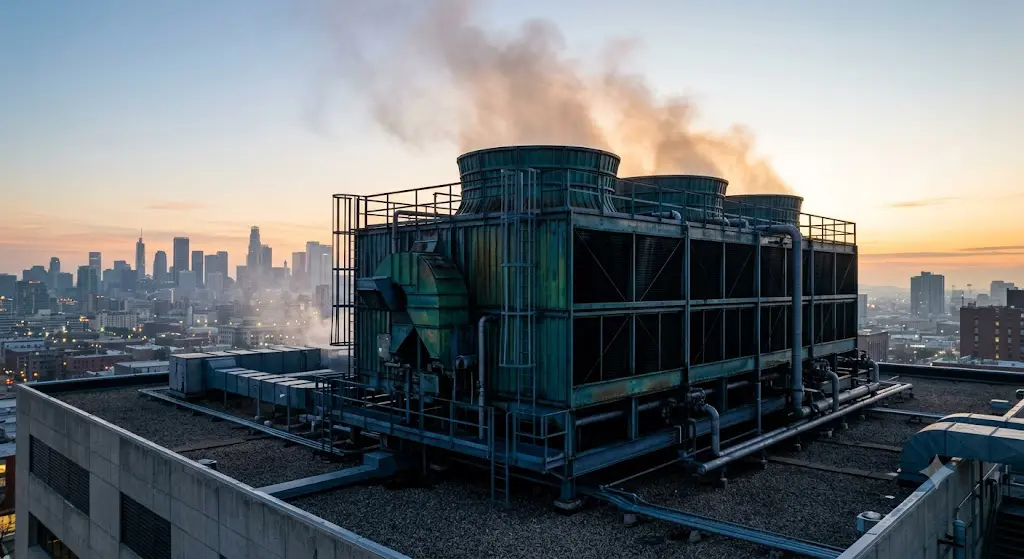
Yes. If you operate a cooling tower, ASHRAE Standard 188 expects you to maintain a written water management program — regardless of what your facility produces or who it serves. This isn’t a gray area. Cooling towers are warm, they aerosolize continuously, and they accumulate exactly the organic material Legionella needs.
They’re also the single most documented source of community Legionella outbreaks, which is why ASHRAE 188 and a growing list of state health codes require management programs for tower operations. New York’s cooling-tower regulations, for example, require registration, routine testing, and a maintenance plan — and other states are following. If you run a large hot-water system with recirculation, you carry stagnation risk at the ends of those runs too, especially during reduced-occupancy periods or seasonal shutdown.
A ChemREADY Legionella water management plan maps your systems, sets your testing schedule, and gives you the documentation ASHRAE 188 and state codes expect — built around your building, not a template.
See What a Water Management Plan Covers →The best-documented Legionella outbreaks in the U.S. didn’t happen in hospitals — they happened in the kinds of buildings most facility managers assume are low-risk. Three cooling-tower outbreaks make the point:
What we typically find on a first assessment is that the manager has been framing this wrong — not out of carelessness, but because “Legionella risk” has been communicated as a healthcare problem in nearly all the industry messaging they’ve seen. Your Legionella treatment services scope is set by what’s running in your building, not by the business you’re in.
A Legionella risk assessment is a structured site walk that maps your water systems, measures the conditions that drive risk, and ends with a plain-English verdict on where you stand. It follows five steps:
The point isn’t to sell you a compliance program you don’t need. It’s to replace an assumption with an answer. If a cooling tower is the concern, that verdict often folds into ongoing cooling tower services and, where it fits, digital remote monitoring so the risk stays managed instead of rediscovered.
If your building has a cooling tower, a large hot-water system, or any equipment that aerosolizes warm water, then yes — Legionella risk applies to you, and the only way to know how much is to look. If it doesn’t, you may be genuinely low-risk, and a short assessment will confirm that just as clearly. Either way, you end up with an answer instead of a hunch.
Most facility managers who ask this question have never had anyone examine their specific systems and tell them where they stand. That’s exactly what a free water analysis is for.
ChemREADY's free on-site water analysis puts an expert in your building. We walk your systems, test your water, and hand you a plain-English report on exactly where you stand — no obligation.
Schedule Your Free Water Analysis →Or call us: 800-229-6801
Book a free on-site water analysis. We'll walk your systems, test your water, and tell you exactly where your Legionella risk stands.
Schedule Your Free Water Analysis →Or call 800-229-6801
Checked any box? Your building is worth a look.
See how ChemREADY builds risk assessments, testing programs, and remediation around your specific systems. View Legionella services →
Treatment, testing, and controls that keep towers compliant and running clean. Explore cooling tower services →
Tell us what's running in your building and we'll point you to the right next step. Start a conversation →
Yes, if your building has a cooling tower, a large recirculating hot-water system, a decorative fountain, or any equipment that aerosolizes warm water. Legionella risk is set by your water systems, not your industry. Office parks, hotels, manufacturing plants, and universities all carry it.
Four conditions together: water held between 77°F and 113°F, stagnation in low-flow or dead-leg sections, scale and biofilm that shield and feed the bacteria, and a mechanism that turns water into breathable aerosol. When all four exist in one system, that system can amplify and disperse Legionella.
Yes. ASHRAE Standard 188 expects any facility that operates a cooling tower to maintain a written water management program, regardless of what the building produces or who it serves. Several states, including New York, add their own registration and testing requirements for cooling towers.
Yes — cooling towers are the single most documented source of community Legionella outbreaks. They are warm, aerosolize continuously, and accumulate the organic material Legionella colonizes. The 2015 New York City, 2019 Atlanta, and 2017 Disneyland outbreaks were all traced to cooling towers, and none occurred in a hospital.
A Legionella risk assessment is a structured site walk that maps your water systems, measures the conditions that drive risk, samples where it matters, and ends with a plain-English verdict — a water management plan, targeted treatment, or confirmation that you’re low-risk.
