ChemREADY

Reading Time | 5 Minutes
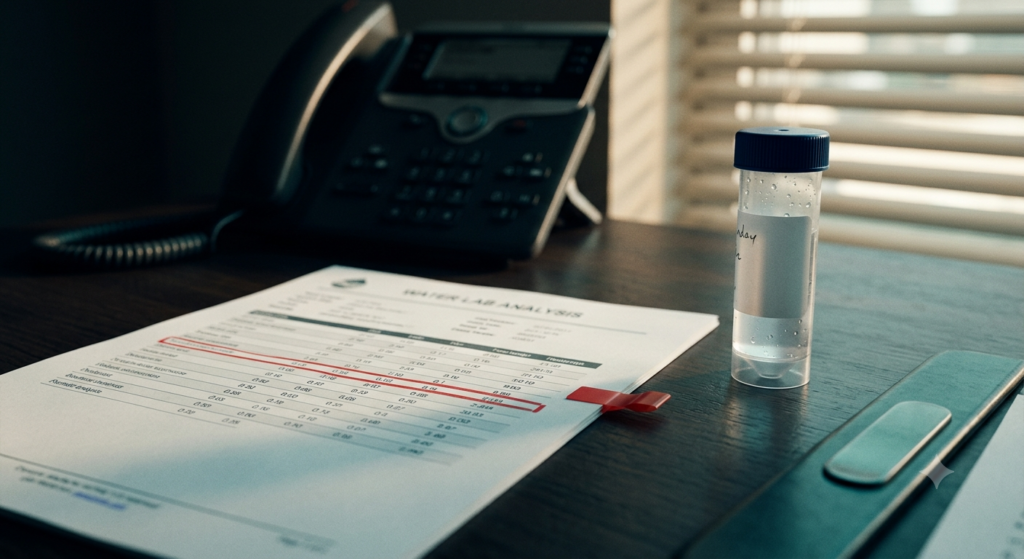
It was a Tuesday morning when the call came in. A facility manager at a mid-size office complex — 400,000 square feet, a cooling tower on the roof, decorative fountains in the lobby — had just received results from a routine water test. One sample came back positive for Legionella pneumophila.
“I didn’t even know what to do first,” he told us later. “I just knew it was bad.”
That call is more common than most facility managers realize. In 2023 alone, the CDC recorded over 10,000 reported cases of Legionnaires’ disease in the United States — and most outbreaks are traced back to building water systems that had no active monitoring program in place.
Here is exactly what happened next — and what every facility manager should know before they ever make that call.
A positive Legionella test means that Legionella bacteria were detected above reportable levels in one or more water samples from your building’s water system. It does not automatically mean an outbreak has occurred. But it does mean the conditions exist for Legionnaires’ disease — a serious, potentially fatal pneumonia — to develop, and immediate action is required.
Legionella is a waterborne bacterium found naturally in the environment. In building water systems, it amplifies when water temperature, stagnation, and low biocide residuals create favorable conditions — particularly in cooling towers, hot water systems, and decorative water features. It spreads through inhaled aerosols, not through drinking water or person-to-person contact.
The first 48 hours are the highest-leverage window. Here is the response protocol we followed — and the sequence that applies to virtually every commercial building scenario.
A Water Management Plan only protects you when it's a living program — scheduled sampling, documented control limits, and someone accountable for the data. See what an operational ASHRAE 188 program looks like.
Explore Legionella Water Management Plans →| Phase | Timeline | Actions |
|---|---|---|
| Immediate (0–4 hrs) | Day 1 | Source isolation, health dept. notification, water treatment specialist on site |
| Short-term (4–48 hrs) | Days 1–2 | Full system walkthrough, shock disinfection, secondary risk point identification |
| Remediation (48–96 hrs) | Days 2–4 | System restart protocols, temperature corrections, biocide program adjustment |
| Validation (1–2 weeks) | Days 7–14 | Post-remediation sampling, confirmatory results, regulatory clearance |
| Long-term (ongoing) | Weeks 2+ | ASHRAE 188-compliant WMP activation or revision, scheduled monitoring program |
ASHRAE 188 is the industry standard that defines how commercial facilities should assess and control the risk of Legionella amplification in their building water systems. It was first published in 2015 and applies to all buildings that serve the public or are occupied by people other than the building owner.
Under ASHRAE 188, a Water Management Plan (WMP) is a documented program — not just a written report — that identifies every water system component that could amplify Legionella, establishes control limits for each, assigns monitoring responsibilities, and defines what happens when a parameter falls out of range.
The facility in this story had a WMP on file. What they did not have was the active monitoring program behind it. Control limits existed in the document. Nobody was checking them.
The cooling tower was the source. That was confirmed by sampling. But the site visit revealed two additional risk points that sampling alone would not have caught.
Hot water recirculation temperature: One wing of the building had a hot water loop running at 128°F. ASHRAE 188 specifies that hot water recirculation lines should be maintained at 124°F or above at the distal points — but most water management programs target 140°F as a practical margin. Below 120°F, Legionella growth accelerates significantly.
Decorative fountain stagnation: A lobby fountain had been taken offline for three weeks for a pump repair, without a disinfection protocol applied during or after the downtime. Stagnant water with no biocide residual is one of the highest-risk conditions in a building water system.
Neither had triggered a complaint. Neither would have been caught without a systematic site walkthrough tied to an active monitoring program.
When we debriefed a few weeks after the response was complete, the facility manager said the same thing we hear after almost every incident of this type.
“I wish I’d had someone looking at this before we got here.”
The difference between a water management plan and a water management program is what happens between test results. A plan tells you what should happen. A program makes sure it does — with scheduled sampling, documented control limits, service records, and someone accountable for the data.
ChemREADY’s technicians catch this kind of issue regularly during routine site visits in facilities that have been under managed programs for years — supported by controllers and automation that hold biocide residuals in range and flag drift before it becomes a positive test. The facility manager in this story caught it after a positive test. The outcome was the same — remediated, documented, resolved — but the path was much harder.
If you manage a commercial building with a cooling tower, a large hot water system, or any decorative water feature, the question isn’t whether your water system could support Legionella growth under the wrong conditions. Most systems can. The question is whether someone is actively watching the conditions. (See also: Legionella cooling tower compliance.)
ChemREADY offers a free on-site water analysis — we'll walk your system, test your water, and give you a plain-English report on what we find. No obligation.
Schedule Your Free Water Analysis →We'll walk your system, test your water, and hand you a plain-English report on your Legionella risk. No obligation.
Schedule Your Free Analysis →Or call 800-229-6801
Legionella Water Management Plans
Turn an ASHRAE 188 binder into an active, monitored program.
Explore WMP services →Cooling Tower Services
Shock disinfection, cleaning, and ongoing biocide control for rooftop towers.
Explore cooling tower services →Already have a positive result?
Don't wait it out. Talk to a specialist who can walk your system and start a response today.
Talk to a specialist →