Reading Time | 10 Minutes
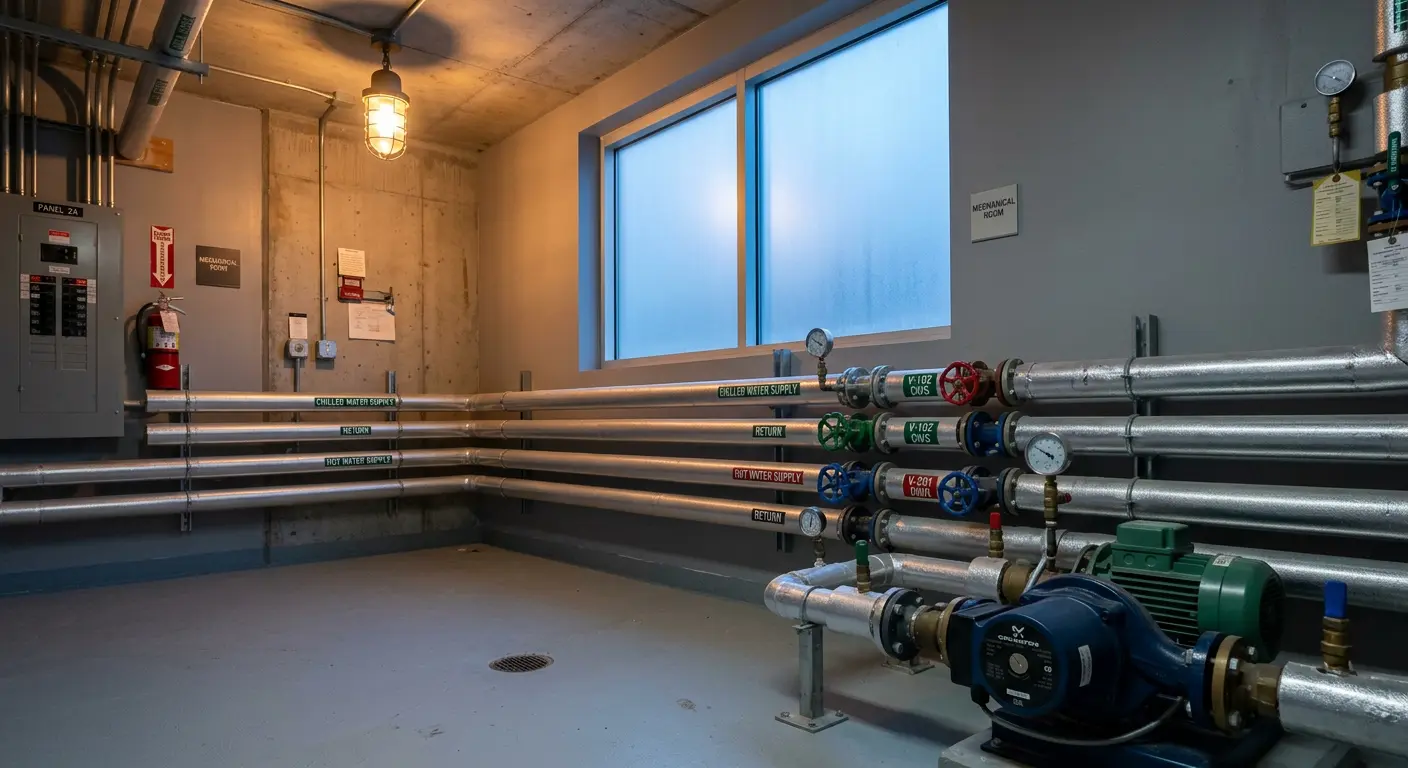
Closed loop freeze protection fails quietly. There’s no alarm, no pressure spike, and no warning before a coil splits or a pump seal lets go at 2 a.m. in January. By then the damage is done, and in most cases a fluid sample pulled in September would have caught it.
It’s exactly the kind of maintenance that gets deferred. That isn’t because facilities don’t care. It’s because nothing visible says anything is wrong. Cooling tower shutdown gets attention, and boiler startup gets attention. The loop circulating chilled water through your air handlers, or hot water through your heat exchangers, gets scheduled for whenever there’s time.
That scheduling decision is where most freeze-season failures start.
Closed loop freeze protection is the practice of keeping a closed hydronic system’s glycol concentration and corrosion inhibitor levels high enough that the fluid won’t freeze and the metals inside won’t corrode at the coldest temperature the system will see. It covers two things at once: the freeze point of the fluid, and the chemistry that protects the pipes, coils, and pumps it runs through.
Unlike an open cooling tower, a closed loop doesn’t lose water to evaporation, so there’s no constant makeup water prompting regular testing. The same fluid circulates for years. Its chemistry changes slowly and silently until something fails.
A properly protected loop has two things: glycol at a concentration matched to your local minimum design temperature, and active inhibitors at levels that protect every metal in the system. That typically means steel, copper, and in some equipment, aluminum.
Glycol concentration drifts down through four common paths:
None of these trigger an alarm. A loop that was filled at 35% propylene glycol, with freeze protection to about 0°F, can drift to 22% over a few seasons. That’s only enough protection to the mid-teens, and nobody notices until the first hard cold snap.
Low glycol creates a second problem. Diluted glycol solutions can feed bacteria, which consume inhibitors and produce more acids. That’s why glycol manufacturers call for adjusted inhibitor levels in more dilute solutions.
The glycol percentage you need depends on your lowest expected temperature and on whether the loop has to keep circulating in that cold. Use the table below. Pick a temperature at least 5°F below the coldest ambient temperature the system could realistically see.
| Lowest Temperature | Propylene Glycol for Freeze Protection (vol %) | Propylene Glycol for Burst Protection (vol %) |
|---|---|---|
| 20°F (-7°C) | 18% | 12% |
| 10°F (-12°C) | 29% | 20% |
| 0°F (-18°C) | 36% | 24% |
| -10°F (-23°C) | 42% | 28% |
| -20°F (-29°C) | 46% | 30% |
| -30°F (-34°C) | 50% | 33% |
| -40°F (-40°C) | 54% | 35% |
Typical values for inhibited propylene glycol heat transfer fluid. Ethylene glycol reaches the same protection at lower concentrations. Always confirm against your glycol manufacturer’s chart for the specific fluid in your system.
Freeze protection keeps the fluid fully liquid and pumpable, with no ice crystals, down to the rated temperature. Burst protection only keeps the fluid from freezing solid and expanding enough to split pipes. Below the freeze point it turns to slush, and it can’t be circulated.
If the loop has to run in the cold, you need freeze protection. That includes chilled water serving air handlers with outside-air coils, heat pump loops, and outdoor dry coolers. Burst protection is only appropriate for piping that sits idle through the cold and has room to handle the expansion of slush. Designing a running loop to burst protection saves on glycol, and then leaves you with slush in the coils on the coldest morning of the year.
Then you don't know whether your loop is protected. ChemREADY's closed loop program measures glycol concentration, freeze point, inhibitor reserve, pH, and corrosion metals from one sample, then corrects what's off before winter.
Explore Closed Loop Services →Corrosion inhibitors in a closed loop do two jobs. They form a protective film on metal surfaces, and they buffer pH against the acids that aged glycol produces. Inhibitors are consumed over time by oxygen that gets in through leaks and air vents, by bacterial activity, and by dilution every time water is added. When they fall below effective levels, the protection disappears, but the system keeps running.
What follows is general corrosion of steel and copper. The corrosion products, iron oxide (including magnetite) and copper oxides, go into suspension and circulate. That causes several problems:
From the outside, a system with depleted inhibitors looks fine. The first physical sign is usually a failed pump seal or a heat exchanger that can’t keep up with load, and that tends to happen at the worst time of year. Magnetic filtration like MagStrainer™ pulls circulating iron debris out of the loop, but it works best alongside restored inhibitor levels, not instead of them.
The only reliable way to know is to test a representative fluid sample. A quick refractometer reading is a start, but it isn’t the whole answer. A refractometer estimates glycol concentration from refractive index. It gives you one number, and only if it’s read on the right scale, because propylene and ethylene glycol read differently. What it can’t tell you is whether:
A full closed loop fluid analysis covers all of that: glycol concentration and freeze point, inhibitor reserve, pH, conductivity, dissolved and suspended metals (iron, copper, aluminum), and biological screening. For facilities that want continuous visibility instead of an annual snapshot, digital remote monitoring tracks loop chemistry and corrosion trends between samples.
Most closed loops should have inhibitor level and pH checked at least quarterly, plus a full fluid analysis, including glycol concentration and freeze point, at least once a year. The best time for that annual analysis is late summer or early fall, when there’s still time to correct before heating season.
Test outside the schedule any time the loop’s fluid changes: after a leak, a drain-and-refill, an equipment replacement, or any makeup water addition. Those events are when concentration and inhibitor levels shift most, and when they’re most likely to go unrecorded.
Work through these steps before temperatures drop:
If a loop needs more than a correction, or the fluid has degraded beyond saving, a full drain and glycol fill with a properly inhibited fluid like ArcticREADY resets the system to a known starting point. Glycol water treatment and closed loop treatment chemistry then keep it there. That means sampling, analysis, treatment, and documentation handled as an ongoing program, not a one-time reaction after something breaks.
If your closed loop hasn’t been tested in the past 12 months, that’s your starting point. Do it now, before the weather raises the stakes. More closed loop guidance is in our Closed Loops WaterFacts library.
ChemREADY's closed loop inhibitors are matched to your system's metals and glycol type, then tested and topped up on a schedule, so protection doesn't quietly run out between seasons.
See Closed Loop Treatment →Closed loop freeze protection is the practice of keeping a closed hydronic system’s glycol concentration and corrosion inhibitor levels high enough that the fluid won’t freeze and system metals won’t corrode at the coldest temperature the system will see. Because closed loops don’t lose water to evaporation, their chemistry changes slowly and silently, so regular testing is the only way to confirm protection.
Test a representative fluid sample from a circulating line, not the fill port. A refractometer gives a quick glycol estimate, but a full fluid analysis also confirms freeze point, inhibitor reserve, pH, corrosion metals, and biological activity, which together determine whether the loop is actually protected.
It depends on your lowest expected temperature and whether the loop must keep circulating. For inhibited propylene glycol, typical freeze protection requires about 29% by volume at 10°F, 36% at 0°F, and 42% at -10°F. Burst protection requires less, but only suits idle piping. Choose a temperature at least 5°F below your coldest expected ambient and confirm against your glycol manufacturer’s chart.
Check inhibitor level and pH at least quarterly, and run a full fluid analysis including glycol concentration and freeze point at least once a year, ideally in late summer or early fall before heating season. Retest after any leak, drain-and-refill, equipment replacement, or makeup water addition.
The protective film on metal surfaces breaks down and pH buffering is lost, so steel and copper begin to corrode while the system keeps running. Iron and copper oxides circulate, deposit on heat exchangers, wear pump seals, and plug strainers and valves. The first visible sign is often a pump or heat exchanger failure during peak season.
Book a free on-site water analysis and get your loops tested and corrected before heating season.
Book Your Free Analysis →Or call 800-229-6801
Inhibited glycol blended to your freeze-protection target, delivered and filled by ChemREADY.
Explore Glycol Fills →Continuous corrosion and chemistry monitoring that flags drift before it becomes a failure.
See Remote Monitoring →Building & Facilities → Healthcare → Manufacturing → Hospitality →
