What Is the Langelier Saturation Index and Why Does It Matter?
The Langelier Saturation Index (LSI) is a calculated value that predicts whether cooling tower water will tend to deposit calcium carbonate scale on surfaces (positive LSI) or corrode metal components (negative LSI). It is calculated from pH, temperature, total dissolved solids, calcium hardness, and alkalinity — and it cannot be determined from a conductivity reading alone.
The LSI value for this facility’s cooling tower was trending mildly negative at the time of our analysis. Not an emergency, but consistent with a system losing corrosion and scale inhibitor residual and trending toward corrosion of heat transfer surfaces over time.
What the Free Water Analysis Found
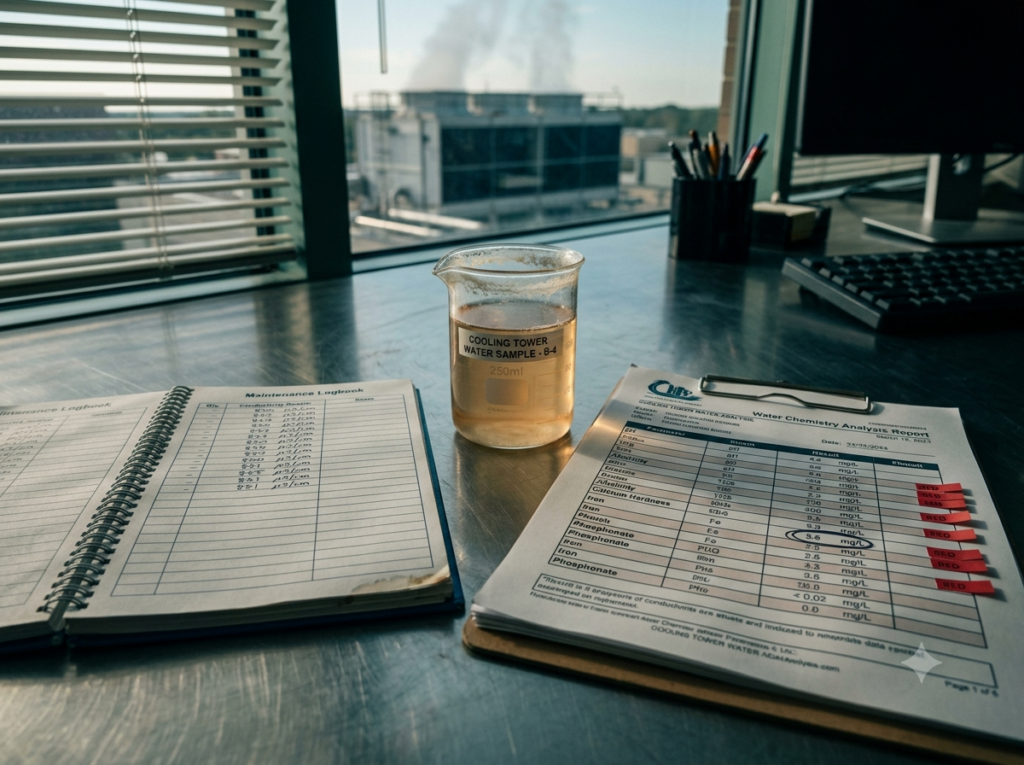
The conductivity log looked fine. That’s the first thing to understand: conductivity alone can look fine while the rest of the chemistry drifts.
When we ran the full panel, three problems emerged.
Bacterial counts were elevated — well above the threshold a managed program should maintain. The biocide program ran on a fixed dosing schedule that couldn’t account for peak summer conditions. In July and August, increased heat load accelerates evaporation, concentrates system chemistry, and creates faster biological growth cycles. A static program that doesn’t adjust for seasonal demand will fall behind.
The Langelier Saturation Index was trending negative, indicating mild corrosion tendency. The fix is straightforward — inhibitor dosage adjustment, ideally held in range by controllers and automation — but left unaddressed, mild corrosion tendency over months becomes visible corrosion, equipment damage, and shortened asset life.
And there was light scaling on the fill media. The fill is where heat transfer happens; scale on that surface reduces efficiency and eventually requires expensive cleaning or side stream filtration to control. It had been building unnoticed for an unknown period.
How to Know If Your Cooling Tower Water Treatment Program Is Actually Working
- Check your service reports for specific readings — not templated language. Every service visit should produce actual parameter values (pH, conductivity, inhibitor residual, bacteria counts) for that visit, not a generic “system looks good.”
- Verify your biocide program is adjusted for seasonal demand. A fixed-dosing schedule that doesn’t account for peak heat load in July and August is not a managed program.
- Confirm someone is calculating LSI, not just conductivity. Conductivity tells you one thing. LSI requires a full chemistry panel and tells you whether your system is trending toward corrosion or scale damage.
- Know your bacteria count threshold and verify it’s being tested. Legionella risk management starts with controlling total bacteria — and you cannot manage what you don’t measure. Continuous monitoring closes the gap between service visits.
- Verify your program documentation is audit-defensible. Can you produce service records, parameter logs, and a water management plan within 15 minutes if asked by a health inspector or insurer?
The Compliance and Liability Angle for EHS
For an EHS director, this isn’t only operational — cooling towers carry documented regulatory exposure. Jurisdictions like New York City (Local Law 77) require annual registration, inspection, and Legionella sampling, and OSHA’s general duty clause creates liability nationally wherever inadequate management can be tied to a Legionella source. We break down the full compliance picture in our companion post on cooling tower Legionella program compliance.
The facility in this case had no water management plan, no biocide adjustment protocol, and no documented bacteria sampling frequency. None of those gaps were visible in the conductivity log — but an audit or incident would have exposed all three. For the regulatory framework itself, see our Legionella services overview.
The Difference Between a Chemical Delivery and a Water Treatment Program
A vendor who shows up every few weeks to drop off chemicals and check conductivity is not running a water treatment program. They are running a delivery route.
A managed program includes:
- Regular, documented water analysis — not just conductivity
- Biocide and inhibitor adjustments based on actual chemistry data
- Bacteria testing at defined intervals
- LSI calculation and scale/corrosion trend monitoring
- Service reports with specific parameter values
- Documentation that satisfies regulatory and audit requirements
The remediation at this facility required an adjusted biocide program, a one-time shock disinfection, and a revised treatment plan with updated inhibitor dosing. None of that was complex. The complexity came from the fact that no one had the data needed to know it was necessary.
There was no problem — until there almost was.