Reading Time | 12 Minutes
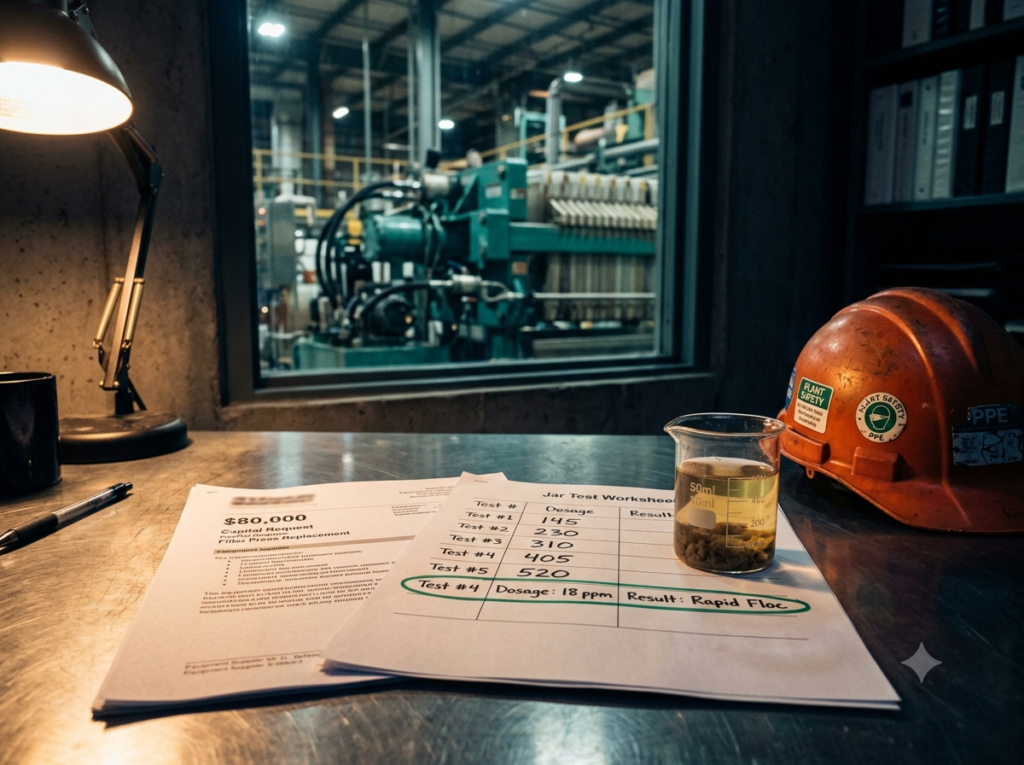
Last spring, a plant manager at a metal fabrication facility called us about a capital request he was building. His filter press — a three-year-old, 30-chamber plate-and-frame unit — had been declining for two years. Longer cycles. Wetter cakes. Hauling bills climbing every quarter. He had a replacement quote in hand: $80,000, plus installation.
His operations director asked him to get a second opinion first.
That second opinion cost a site visit. It saved him $80,000.
A filter press is mechanical equipment that separates solids from liquid in industrial wastewater or process sludge. Sludge is pumped into chambers between filter plates under pressure, liquid is forced through the filter media, and the solid “cake” that remains is ready for disposal or reuse. Performance is measured in cycle time, cake solids percentage, and filtrate clarity.
When a filter press starts producing wet cakes — cakes with higher-than-expected moisture content — or running longer cycles than at startup, the instinct is to look at the equipment. Worn plates. Degraded filter cloth. Feed pump problems. End of service life.
All of those can be genuine causes. But in our experience, the most commonly overlooked root cause is the polymer program upstream of the press.
Polymer is a chemical conditioning agent that binds fine suspended particles in sludge into larger, faster-draining clumps called flocs before the sludge reaches the filter press. The right polymer type, molecular weight, charge density, dose rate, and mixing energy for a specific sludge directly determines how efficiently the press can remove water under mechanical pressure.
The wrong polymer program — or the right program applied to a sludge that has changed composition since commissioning — means the press is working against poor floc structure from the first stroke of every cycle. No amount of mechanical adjustment fixes a chemistry problem.
One facility was staring at an $80K press replacement. A jar test dropped cycle times 35% and shelved the spend. See what degraded dewatering is actually costing you before you sign off on new equipment.
Calculate Your Dewatering ROI →| Symptom | Most Likely Cause | First Diagnostic Step |
|---|---|---|
| Wet cakes, high moisture content | Polymer mismatch or underdosing | Jar test with current sludge |
| Cycle times increasing over months | Sludge composition shift | Solids characterization + polymer re-evaluation |
| Inconsistent cake quality shift-to-shift | Sludge variability not accounted for | 24-hr composite sampling + program adjustment |
| Filter cloth blinding/plugging | Fines not captured by polymer; or wrong cloth | Polymer jar test + cloth evaluation |
| High filtrate turbidity | Insufficient polymer or wrong charge | Jar test for floc settling |
| Fine at startup, declining over 6–18 months | Chemistry not adjusted as process changed | Full program re-evaluation |
When our team arrived at the metal fabrication facility, the press was in reasonable mechanical condition. What we found was that the polymer program — fixed at commissioning three years earlier — had never been adjusted despite changes in the facility’s process chemistry and sludge characteristics.
We ran jar tests: bench-scale mixing trials that let us evaluate a range of polymer types, charge densities, and dose rates against current sludge samples before making any changes to the production system. Jar tests are the standard diagnostic tool for polymer program optimization and take 2–4 hours to yield actionable results.
After identifying a better-performing polymer formulation and recalibrating the feed system, the results were measurable: cycle times dropped approximately 35%, cake solids increased, and hauling volume declined. The $80,000 capital request was shelved.
The press was not broken. It had been set up to fail on every cycle.
Most facilities treat dewatering chemistry as a fixed cost after commissioning. The equipment gets attention — cloths get replaced, plates get inspected, pumps get maintained. The chemistry program runs on autopilot.
The problem is that industrial sludge is not static. Composition changes as process chemistry changes. Seasonal variation in raw material affects it. Production volume shifts affect it. And a polymer program set up for the sludge you had at commissioning may be significantly mismatched from the sludge you have today.
This is something our technicians see consistently across dewatering operations in manufacturing, mining, construction, and food processing. The equipment is fine. The chemistry stopped working somewhere along the way, and nobody noticed because performance degraded gradually rather than failing suddenly — the kind of slow drift that continuous monitoring catches long before it shows up in your hauling bill.
A gradual decline over 18 months looks like a capital problem. A site visit and a jar test reveals a chemistry problem that costs a fraction of new equipment. (Related: if your filtrate is the issue rather than your cakes, see filter press filtrate discharge compliance.)
Before you request a capital spend, take these steps:
ChemREADY offers a free on-site analysis — we'll walk your dewatering system, evaluate your chemistry program, and give you a plain-English read on what's driving your results, including a look at your filter press polymer program. No obligation.
Schedule Your Free Water Analysis →We'll walk your press, evaluate your polymer program against current sludge, and hand you a plain-English read on what's driving your results. No obligation.
Schedule Your Free Analysis →Or call 800-229-6801
Dewatering Optimization Consulting
Re-test your polymer program against current sludge and recover lost throughput.
Explore optimization consulting →Filter Presses & Equipment
Plate-and-frame presses sized and serviced for your sludge and throughput.
Explore filter presses →About to buy a new press?
Get a second opinion first. A jar test and a site visit often cost a fraction of a capital request — and sometimes make it unnecessary.
Get a second opinion →