Langelier Saturation Index: What Your LSI Means

Reading Time | 15 Minutes

Your cooling tower water report almost certainly includes a number labeled LSI. Most plant engineers scan right past it.

That’s a mistake. The Langelier Saturation Index is one of the few numbers on that page that combines five separate test results into a single answer. Is this water trying to deposit scale on your heat exchanger tubes, or trying to strip protective deposits off your piping? The LSI tells you before either problem shows up as a rising approach temperature, a leaking tube, or a chiller working harder than it should.

It’s also one of the most misread numbers on the report. A positive LSI in a treated cooling tower isn’t automatically a problem, and a “balanced” zero isn’t automatically the goal. Here’s how to read it correctly.

What Is the Langelier Saturation Index?

The Langelier Saturation Index (LSI) is a calculated value that shows whether water will deposit or dissolve calcium carbonate. It equals measured pH minus saturation pH (pHs). A positive LSI means scale-forming water, a negative LSI means water that dissolves scale and protective deposits, and zero means equilibrium.

Wilfred F. Langelier, a sanitary engineering professor at the University of California, Berkeley, introduced the index in a 1936 paper in the Journal of the American Water Works Association. Nearly 90 years later, it remains the most widely used screening tool for calcium carbonate scaling tendency in cooling water, municipal distribution systems, and pools.

One distinction matters before anything else: the LSI measures tendency, not outcome. It tells you which direction calcium carbonate wants to move. It doesn’t tell you how fast, whether your inhibitor is holding it in solution, or what’s happening with other deposits like calcium phosphate or silica. That’s why it has to be read alongside the rest of your program data.

How Do You Calculate the Langelier Saturation Index?

The formula itself is short:

LSI = pH − pHs

pH is your measured value. pHs, the saturation pH, is the pH at which your water would sit in exact equilibrium with calcium carbonate, given its current mineral content and temperature. The widely used approximation calculates pHs from four factors:

  1. A (dissolved solids): A = (log10[TDS, mg/L] − 1) ÷ 10
  2. B (temperature): B = −13.12 × log10(°C + 273) + 34.55
  3. C (calcium hardness): C = log10[Ca hardness as CaCO3, mg/L] − 0.4
  4. D (alkalinity): D = log10[M-alkalinity as CaCO3, mg/L]

Then: pHs = (9.3 + A + B) − (C + D)

Worked example: a typical treated cooling tower

Recirculating water: pH 8.4 · TDS 1,200 mg/L · 95°F (35°C) · calcium hardness 400 mg/L · M-alkalinity 300 mg/L (both as CaCO3)

A = 0.21 · B = 1.90 · C = 2.20 · D = 2.48
pHs = (9.3 + 0.21 + 1.90) − (2.20 + 2.48) = 6.73
LSI = 8.4 − 6.73 = +1.67

Now run the same water at the heat exchanger tube wall, where skin temperature might reach 140°F (60°C). B drops to 1.45, pHs drops to 6.28, and the LSI climbs to +2.12, without a single change in the water itself.

That second calculation is the one most reports skip. Calcium carbonate becomes less soluble as temperature rises, so the hottest surface in your system is always where scale forms first. An LSI calculated at basin temperature describes the basin. It doesn’t describe your chiller condenser tubes. A well-run program evaluates the index at maximum skin temperature, not just bulk water temperature.

What Does a Positive or Negative LSI Mean?

The sign tells you the direction. The magnitude tells you how strong the push is. Here’s how to read the number in a cooling tower context:

LSI ValueWhat the Water Is DoingRisk in Untreated WaterWhat It Means in a Treated Cooling Tower
Below −0.5Strongly undersaturated; dissolves calcium carbonateNo protective film; aggressive toward mild steel and galvanized surfacesUncommon. Usually acid overfeed, very soft makeup, or very low cycles. Investigate now.
−0.5 to 0Mildly undersaturatedMild corrosive tendencyCheck corrosion coupon rates and corrosion inhibitor residual
0 to +1.0Mildly supersaturatedLight scale over timeEasily controlled by nearly any inhibitor program
+1.0 to +2.5Supersaturated; scale-formingSignificant scale on heat transfer surfacesCommon operating zone for treated alkaline programs, but safe only with inhibitor at target residual
Above ~+2.5Strongly scale-formingHeavy, rapid scaleAt or beyond the limit of many conventional inhibitor programs; scale starts at the hottest surfaces

Notice the gap between the last two columns. That gap is the entire reason cooling tower chemical programs exist.

What Is a Good LSI for a Cooling Tower?

There isn’t one universal number. If someone gives you “−0.5 to +0.5” as a cooling tower target, they’re quoting guidance written for untreated water.

For water with no chemical treatment, an LSI near zero to slightly positive is the goal. That’s enough saturation to avoid dissolving protective deposits, but not enough to build scale. Pool and drinking water guidance lives in this range.

Treated cooling towers deliberately run higher. Evaporation concentrates calcium and alkalinity with every cycle, and pH rises as CO2 strips out across the fill. A tower running several cycles of concentration on moderately hard makeup water will naturally land well above +1.0. Running there is intentional. It saves water, and mildly scale-forming water is far less aggressive toward mild steel than corrosive water.

What keeps that water from scaling is the inhibitor. Corrosion and scale inhibitors such as phosphonates and polymer dispersants hold calcium carbonate in a supersaturated state. They also distort the crystals that do form, so those crystals don’t bond to heat transfer surfaces. Many treated alkaline programs operate between roughly +1.0 and +2.5. Somewhere around +2.5 to +3.0, conventional inhibitor chemistry reaches its limit, and scale starts forming at the hottest surfaces first.

So the right question isn’t “Is my LSI positive?” It’s “What is my LSI ceiling, and how close am I running to it?” That ceiling depends on three things specific to your system:

  • Your inhibitor chemistry and residual. Different formulations tolerate different saturation levels, and only at the residual they were designed for.
  • Your maximum skin temperature. Higher heat flux means a lower safe LSI in the bulk water.
  • Your metallurgy. Galvanized basins, copper tubes, and mild steel piping each respond differently, especially at the low end of the range.

If your water treatment provider hasn’t told you what LSI range they’re managing to, and why, that’s worth a direct question. Our complete cooling tower water treatment guide covers how LSI targets fit alongside cycles, biocide, and corrosion control.

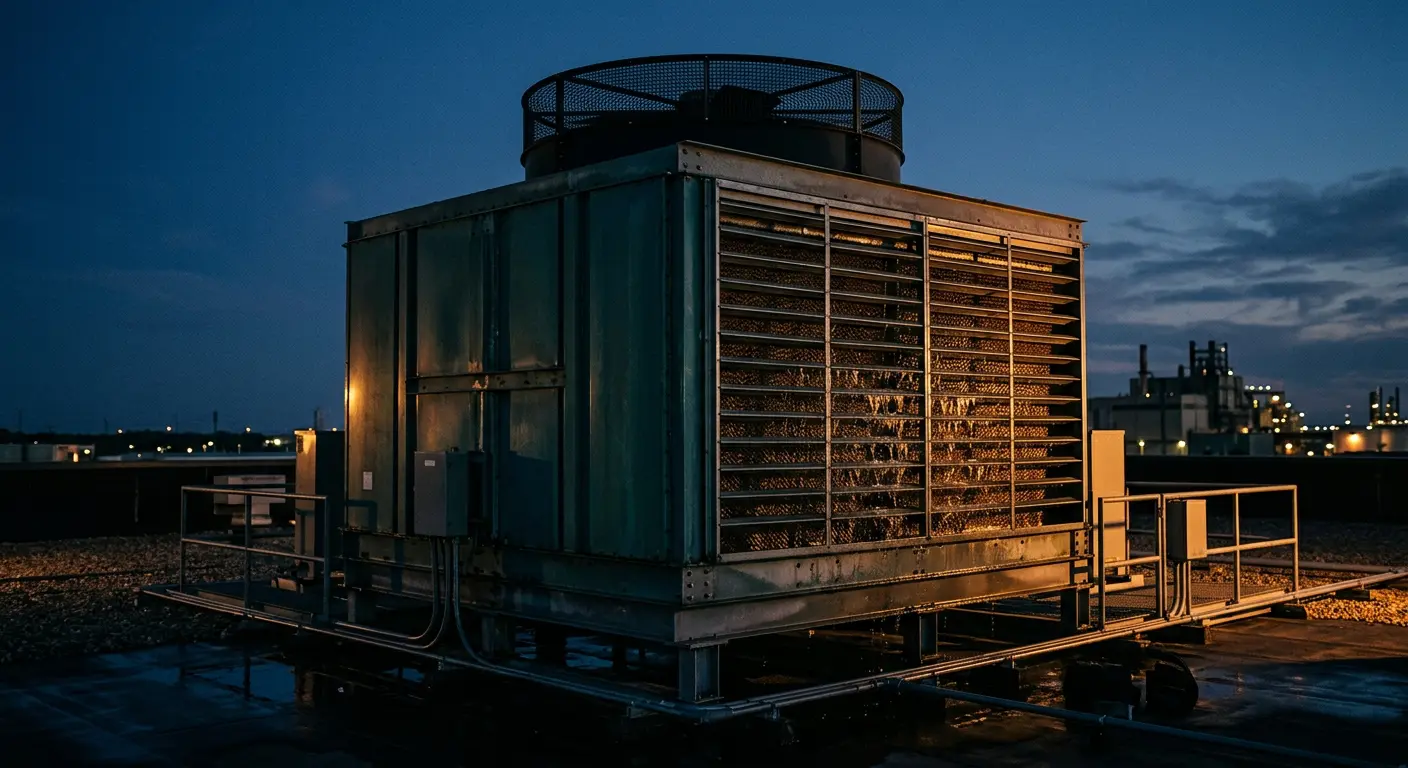
If no one can tell you your LSI ceiling, no one is managing to it.

ChemREADY's cooling tower services set LSI and cycles targets from your makeup water, heat load, and metallurgy. We test against those targets at every visit and adjust when conditions shift, so the number on your report leads to a decision.

See Our Cooling Tower Services →

What Causes the LSI to Change in a Cooling Tower?

The LSI moves whenever any of its five inputs move, and in a cooling tower all five are moving constantly. The most common drivers:

  • Cycles of concentration creeping up. A stuck blowdown valve, a fouled conductivity probe, or a setpoint changed during a service call raises calcium, alkalinity, and TDS together. This is the most common cause of a rising LSI. Drift in conductivity controllers and blowdown automation can push the index up for weeks before anyone notices.
  • pH drift. With everything else held constant, pH moves the LSI one-for-one: a 0.3 rise in pH is a 0.3 rise in LSI. In towers with acid feed, an empty acid drum sends the LSI up fast. An overfeeding pump sends it negative, sometimes low enough to attack the system you’re trying to protect.
  • Heat load and temperature. Summer peak load raises both bulk and skin temperatures, lifting the LSI at exactly the surfaces that matter most.
  • Makeup water changes. Municipal utilities often switch or blend sources seasonally, which can substantially change hardness and alkalinity. A program set up on spring makeup data may be running a very different LSI in August.
  • Chemical feed interruptions. The LSI itself doesn’t change when the inhibitor runs out, but the safe ceiling does. Same number, no protection.

That last point is why the LSI can’t be read in isolation.

What the LSI Doesn’t Tell You

The LSI is a screening tool. It’s valuable, but it has blind spots every plant engineer should know:

  • It covers calcium carbonate only, not calcium phosphate, calcium sulfate, silica, or iron deposits.
  • It doesn’t account for inhibitors. The calculation assumes untreated water, which is why treated towers can safely run “above spec.”
  • It doesn’t measure corrosion. A negative LSI signals that water won’t lay down a protective carbonate film. Actual metal loss also depends on dissolved oxygen, chlorides, velocity, and microbiology. Corrosion coupons measure what’s really happening.
  • It’s a snapshot. One monthly calculation can’t show the three weeks the controller was offline.

Two companion indices are often reported alongside it:

Index Formula How to Read It Best Used For
Langelier Saturation Index (LSI) pH − pHs Above 0 scale-forming; below 0 undersaturated Direction of calcium carbonate tendency
Ryznar Stability Index (RSI) 2(pHs) − pH Below 6.0 scale-forming; 6.0–7.0 near balance; above 7.0 increasingly corrosive Gauging severity, not just direction
Puckorius Scaling Index (PSI) 2(pHs) − pHeq Same scale as RSI, but uses an equilibrium pH calculated from alkalinity Highly buffered cooling water where measured pH can mislead

None of these replaces trend data. Digital remote monitoring tracks pH, conductivity, and chemical feed continuously, so drift shows up as a trend line instead of a surprise on next month’s report.

What Should You Do If Your LSI Is Out of Range?

Start by identifying which input moved. Adjusting chemistry before you know the cause usually creates a second problem.

  1. Confirm the reading. Recheck pH with a calibrated meter, and verify that calcium hardness and alkalinity were reported as CaCO3. A pH meter that’s a few tenths off moves the LSI by the same amount.
  2. Recalculate at skin temperature. If the report used basin temperature, rerun the index at your hottest heat exchanger surface.
  3. Check cycles of concentration. Compare tower conductivity to makeup conductivity. If cycles are above target, inspect the blowdown valve, conductivity probe, and controller setpoint before touching chemical feed.
  4. Verify inhibitor residual. A high LSI with a low residual is a scaling event in progress. A high LSI with an on-target residual may be within design limits.
  5. Review acid feed, if you have it. Low LSI with low pH usually points to acid overfeed. High LSI with high pH points to an empty tank or failed pump.
  6. Pull corrosion coupon and deposit data. Coupon rates and heat exchanger inspection results confirm whether the LSI’s prediction is showing up in the metal.
  7. Test your makeup water. If everything above checks out, the source water may have changed. That means the targets need resetting, not just the chemistry.

Why an LSI on a Report Isn’t the Same as an LSI Under Control

Every water treatment report can print an LSI. The software calculates it automatically. The difference between programs is what happens after the number is printed.

One of the most common things we find when we walk a cooling tower for the first time is an LSI that has been drifting upward for months. It’s visible on every report, and no one has acted on it. The makeup water changed, or a conductivity probe fouled and cycles crept up. Each monthly visit recorded the number without asking what was driving it. The first thing anyone noticed was a rising approach temperature on the chiller.

A drop-off arrangement delivers inhibitor and prints a report. A managed program sets an LSI range based on your makeup water, heat load, metallurgy, and the treatment chemistry in your tower. It then treats a reading outside that range as a problem to diagnose, not a number to file. That’s the difference between having data and having control.

Our cooling tower water treatment program is built on that second model.

Find out what your LSI is actually telling you, and which input is driving it.

ChemREADY offers a free on-site water analysis. We'll walk your system, test your makeup and tower water, and give you a plain-English report on what we find. No obligation.

Schedule Your Free Water Analysis →

Or call us: 800-229-6801

Langelier Saturation Index FAQs

What is the Langelier Saturation Index?

A calculated value showing whether water will deposit or dissolve calcium carbonate. It equals measured pH minus saturation pH (pHs). Positive values indicate scale-forming water, negative values indicate water that dissolves calcium carbonate, and zero indicates equilibrium.

What is a good LSI for a cooling tower?

It depends on treatment. Untreated water should sit near zero to slightly positive. Treated alkaline cooling towers commonly run between about +1.0 and +2.5 because inhibitors hold calcium carbonate in solution. The safe ceiling depends on inhibitor chemistry, residual, skin temperature, and metallurgy.

What does a negative LSI mean?

The water is undersaturated with calcium carbonate. It won’t form a protective carbonate film and will dissolve existing deposits, which increases corrosion tendency. Below −0.5 in a cooling tower usually points to acid overfeed, very soft makeup, or very low cycles, and should be investigated with corrosion coupon data.

How do you calculate the Langelier Saturation Index?

LSI = pH − pHs. The saturation pH is calculated as pHs = (9.3 + A + B) − (C + D), where A reflects total dissolved solids, B temperature, C calcium hardness, and D alkalinity. Calculate it at the hottest heat transfer surface temperature, not just basin temperature.

What causes the LSI to change in a cooling tower?

Changes in any of its inputs: rising cycles of concentration, pH drift from acid feed problems, higher heat load and skin temperature, and seasonal makeup water changes. Rising cycles caused by blowdown or controller problems are the most common driver.

Talk to someone who reads cooling tower chemistry for a living, not a call center.

Book a 30-minute conversation about your tower, your water reports, and what the numbers are telling you. We listen first. No high-pressure close, ever.

Book a 30-Minute Call →

Free Cooling Tower Checklist

Confirm your current chemistry is protecting equipment and holding heat transfer. These are the same points we check when an LSI starts moving.

Get the Checklist →

See where you stand before you talk to anyone.

Scale control, corrosion, blowdown, biocide, and monitoring. Look at how our cooling tower services work first, then decide if a conversation makes sense.

See how our cooling tower program works →

Browse the chemistry behind LSI control.

Phosphonates, polymer dispersants, and corrosion inhibitors, at your own pace. No conversation required.

Explore corrosion and scale inhibitors →

Engineers, contractors, and facility consultants:

If you’re seeing scale or corrosion at client cooling towers and need a treatment partner for evaluation or program takeover, let’s talk.

Start a partner conversation →