Reading Time | 10 Minutes
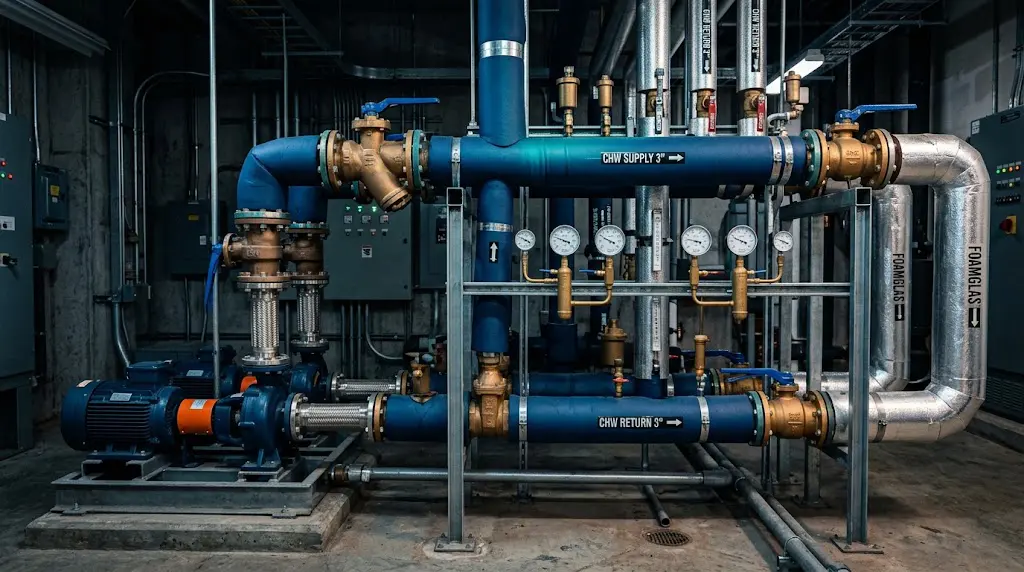
Every facility manager knows cooling towers need attention in summer. Legionella programs, blowdown rates, scale and corrosion chemistry — it’s all front of mind when the heat index climbs and the towers are running hard.
Closed loop systems don’t get that attention. That’s exactly the problem.
Closed loop water treatment — maintaining the chemistry of chilled water loops, hot water heating loops, and process cooling circuits — tends to get scheduled around convenience. In summer, that convenience never comes. And the cost of skipping it isn’t abstract: a fouled heat exchanger or a corroded chilled water coil can run from several thousand to well over ten thousand dollars to replace, plus the downtime to pull it offline and do the work.
A closed loop is a recirculating system. No evaporation. No visible drift. No cycles of concentration climbing in real time. Because nothing is visibly happening, it’s easy to assume nothing actually is.
A closed loop water system is a recirculating water circuit — a chilled water system, hot water heating loop, or process cooling circuit — that doesn’t exchange water with the environment. Because there’s minimal evaporation or blowdown, inhibitor levels deplete through chemical consumption rather than dilution, which makes scheduled chemistry monitoring essential.
That sealed design is exactly why closed loops get overlooked. A cooling tower advertises its condition — you can see the drift, measure the cycles, watch the conductivity climb. A closed loop gives you almost none of that. Makeup water is minimal, so nothing forces you to interact with the system day to day. Meanwhile the corrosion inhibitor is quietly doing its job — forming a protective film on interior metal surfaces — and quietly running down as it’s consumed. Biology can still establish itself in low-flow zones and anywhere the loop picks up ambient heat. The system keeps circulating, and the chemistry keeps drifting, with no visible signal that anything has changed.
Summer accelerates closed loop problems because chilled water systems run continuously under peak load while facility attention shifts almost entirely to cooling towers. Both things happen at once, and they compound.
Higher loads mean more frequent circulation, which accelerates inhibitor consumption through chemical reaction with metal surfaces. Any ambient heat gain into the system — from insulation gaps, unlagged piping, or proximity to heat-generating equipment — creates temperature conditions that favor biological growth. The same season that has your team focused on cooling tower services is the season your closed loops are working hardest and depleting fastest.
Facilities running on a chemical drop-off schedule have no way to know when a closed loop’s inhibitor level has drifted below the effective range. Nobody’s pulling samples. Nobody’s adjusting. The chemistry runs wherever it runs, and the first signal is often a failed component.
When closed loop corrosion inhibitors drop below their effective range, the protective film they maintain on interior metal surfaces breaks down, bare metal is exposed to oxygenated water, and corrosion begins — often within weeks of crossing the threshold, not months.
Closed loop corrosion and scale inhibitors — typically nitrite-based, molybdate-based, or a blend selected for the system’s metallurgy — work by forming that protective film across steel, copper, and mixed-metal surfaces inside the loop. When levels fall, the film fails first in the most vulnerable spots: high-turbulence sections, low-flow dead legs, and any area already carrying deposit.
What we typically find when we pull samples from a closed loop that hasn’t had professional attention in a year or more: inhibitor below threshold, elevated heterotrophic plate counts, and a reddish-brown particulate that means corrosion has been active for a while. The system is running. It just isn’t running clean.
Our closed loop services cover sampling, inhibitor management, and biological control on a schedule built around your systems — not around whoever remembers to check.
See our closed loop services →Those byproducts don’t stay put. They circulate through the loop, foul heat exchanger surfaces, and reduce thermal efficiency — which often gets logged as “the building runs warm in summer” before anyone looks at the water chemistry. They abrade pump seals. They collect in low-flow zones and create conditions for under-deposit corrosion that can perforate tubing from the inside out.
Most closed loop problems show up in the water and the equipment long before they show up as a failure. These are the signals worth acting on:
A managed closed loop program monitors a short, specific list of parameters — quarterly at minimum, and more often on critical systems. These are the ranges that matter:
| Parameter | Target Range | Frequency | Why It Matters |
|---|---|---|---|
| pH | 7.5 – 9.5 | Quarterly min | Controls corrosion rate; low pH accelerates iron corrosion, high pH risks calcium carbonate scale in mixed systems. |
| Conductivity | Program-specific (µS/cm) | Quarterly min | Indicates dilution, inhibitor depletion, or contamination. Significant drift means investigate the makeup water source. |
| Corrosion inhibitor conc. | Per program spec (ppm) | Quarterly min | Below threshold, the protective film breaks down. Trend data matters more than any single reading. |
| Heterotrophic plate count | < 500 CFU/mL | Quarterly min | Elevated counts signal biological activity; biocide treatment and a source investigation follow. |
| Visual appearance | Clear to light amber | Each service visit | Reddish-brown = active iron corrosion; black = anaerobic bacteria. Either requires immediate sampling. |
| Dissolved oxygen | < 0.1 ppm | Annually | High DO in a closed loop means air intrusion — a major corrosion driver. Check expansion tank, pump seals, and fill connections. |
Monitoring a closed loop is a repeatable six-step process that takes less than an hour per system:
Closed loop services aren’t complicated, but they are unforgiving of neglect. On critical systems — chilled water serving data centers, healthcare, or process-critical equipment — monthly testing and digital remote monitoring earn their keep by catching drift between visits instead of after a failure. Biological problems in particular need both treatment and root-cause work: a biocide dose without a source investigation just resets the clock.
Without scheduled testing, you don’t know when you’ve crossed the threshold. Closed loops don’t announce when they need attention. You find out when something fails.
This summer, if your cooling towers are getting all the attention and your closed loops are running on autopilot, pull a sample. The window where nothing has failed yet is exactly the right time to look.
Schedule your free water analysis. We'll walk your systems and test the loop chemistry — cooling towers and closed loops both. No obligation.
Schedule your free water analysis →One visit tells you where your inhibitor levels, biological counts, and corrosion activity actually stand. Cooling towers and closed loops both.
Schedule your checkup →Or call us directly: 800-229-6801
Scheduled sampling, inhibitor management, and biological control built around your systems.
View closed loop services →Digital remote monitoring catches inhibitor drift and biological activity between service calls.
See remote monitoring →Take the Water Confidence Assessment — five minutes to see how your current program stacks up across every system you run.
Take the assessment →