Reading Time | 10 Minutes
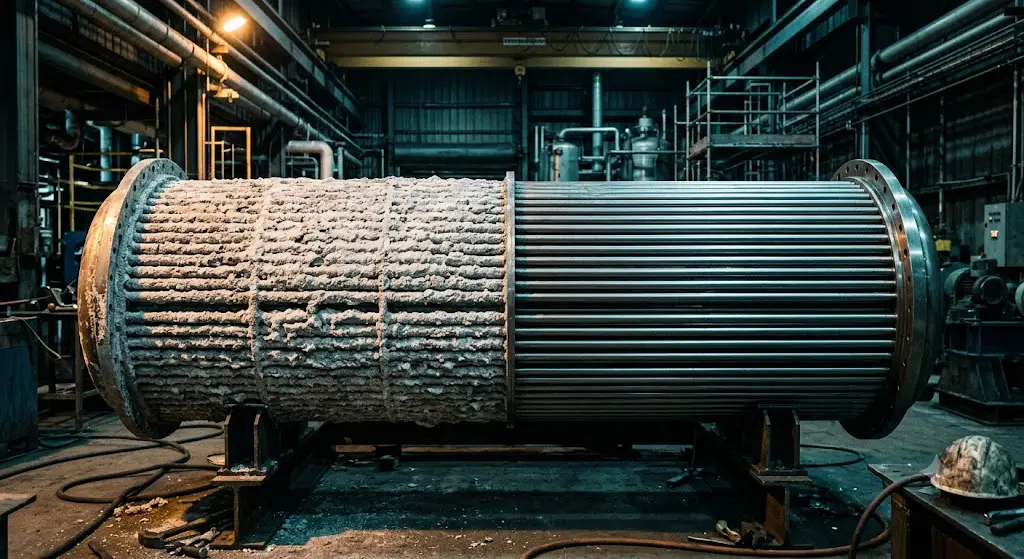
A plant engineer at a plastics manufacturing facility had been fighting cooling tower scaling for over a year. His approach was logical: the scale inhibitor wasn’t working well enough, so he increased the dose. When that didn’t fix it, he increased it again. By the time he called us, he was spending close to $2,000 a month on treatment chemistry — and still pulling fouled heat exchangers every quarter.
The chemistry wasn’t the problem. Nobody had looked at how the tower was actually running.
A cooling tower scales despite a treatment program when its operating parameters — most often cycles of concentration — have drifted outside the range the chemistry was formulated for. Every scale inhibitor works within a specific operating window. Push the tower past that window and no amount of added product can compensate, because you’re asking the chemistry to do something it was never built to do.
That’s why “add more inhibitor” so often fails. More product doesn’t widen the operating range — it just raises your chemical spend while the real variable goes unwatched. And the real variable is almost always how concentrated the water has become.
Cycles of concentration is the ratio of dissolved mineral concentration in the tower’s basin water to the concentration in the incoming makeup water. A tower running at 4 cycles has water four times as concentrated as its supply; at 8 cycles, eight times. It is the single most important operating parameter in cooling tower chemistry — and the one most likely to drift without anyone noticing.
Here’s the mechanism. Cooling towers reject heat through evaporation. Every time water evaporates, the dissolved minerals it carried — calcium, magnesium, silica, alkalinity — stay behind and concentrate in the remaining basin water. Left unchecked, that concentration climbs until minerals exceed their solubility limit and precipitate out as hard scale. Your corrosion and scale inhibitor program is designed to hold those minerals in solution — but only across a specific CoC range.
Blowdown controls scaling by intentionally discharging a portion of the concentrated basin water and replacing it with fresh makeup water, bringing cycles of concentration back down into range. It is the primary lever for keeping CoC where the treatment program expects it. When the blowdown controller is miscalibrated, every other part of the program is working against a moving target.
Blowdown is usually automated on a conductivity setpoint: when basin conductivity climbs past a threshold, a valve opens and dumps concentrated water. That only works if the setpoint still matches reality. Several things quietly push CoC out of range:
| What Drifts | Why It Happens | Result |
|---|---|---|
| Makeup water chemistry | Utility changes its treatment or source; mineral balance shifts | Old setpoint no longer maps to the same CoC |
| Controller calibration | Setpoint never revisited after commissioning | Tower runs at a CoC no one chose |
| Conductivity probe | Probe fouls or scales over and misreads | Blowdown fires on bad data |
| Seasonal load | Evaporation rate swings with weather and production | A static setpoint fits only part of the year |
The tower’s blowdown controller hadn’t been recalibrated in over a year. Its conductivity setpoint made sense when the program was first established — but the previous winter, the local water utility had changed its treatment approach and shifted the mineral balance of the incoming supply. Nobody updated the program to match.
The result: the tower was running at nearly 9 cycles of concentration. The cooling tower water treatment program had been designed for a 4–5 CoC range. The inhibitors weren’t failing. They were operating in conditions they were never formulated for — roughly double the concentration the program assumed.
We recalibrated the blowdown controller, updated the conductivity setpoint to reflect the current makeup water chemistry, and adjusted inhibitor dosage to match the corrected operating range. Thirty days later, the plant engineer pulled a heat exchanger that was clean for the first time in over a year.
Chemical spend dropped by about 40% — not because we changed products, but because the tower was finally running inside the parameters the program was built around. We also put the tower on digital remote monitoring, so conductivity is tracked in real time and drift gets caught before it shows up as scale. Where a tower’s setpoint logic needs to flex with the seasons, updated blowdown controllers and automation do that work continuously instead of once a year.
ChemREADY's cooling tower services check the operating parameters most programs never revisit — CoC, blowdown calibration, and makeup water chemistry — so your chemistry works in the conditions it was built for.
Explore Cooling Tower Services →You can catch cycles-of-concentration drift before it becomes scale with a five-minute check against your own data. Run these five steps:
Where suspended solids are also part of the picture, side-stream filtration keeps them from settling out and seeding deposits — but the parameter check comes first.
This is one of the most commonly misdiagnosed issues in cooling water treatment: the chemistry is correct in theory, but operating parameters have drifted out of range and no one is watching. It happens quietly — no alarms, no obvious failures — until something that should be clean isn’t. The same drift shows up on boilers, where an uncalibrated blowdown cycle wastes fuel and treatment the same way it wastes them here.
If your tower is scaling and your chemistry looks right on paper, check your cycles of concentration. The answer is usually there.
ChemREADY's free on-site water analysis checks your CoC, blowdown calibration, and makeup water chemistry, then hands you a plain-English report on where your program actually stands — no obligation.
Schedule Your Free Water Analysis →Or call us: 800-229-6801
Book a free on-site water analysis. We'll check your cycles of concentration, blowdown calibration, and makeup water chemistry, and tell you exactly where your program stands.
Schedule Your Free Water Analysis →Or call 800-229-6801
Checked any box? Your setpoint is worth a second look.
Treatment, testing, and parameter control that keeps towers clean and running within spec. Explore cooling tower services →
Real-time conductivity tracking flags CoC drift before it becomes scale. See digital remote monitoring →
Tell us what your tower is doing and we'll help you find the variable that's been missed. Start a conversation →
Because the tower is usually running outside the operating range the chemistry was formulated for — most often a cycles-of-concentration level that has drifted too high. Scale inhibitors only hold minerals in solution across a specific CoC range. Past that range, adding more product doesn’t help; it just raises cost while the real variable goes unmanaged.
Cycles of concentration (CoC) is the ratio of dissolved mineral concentration in the tower’s basin water to the concentration in the makeup water. A tower at 4 cycles has water four times as concentrated as its supply. It is the most important operating parameter in cooling tower chemistry and the one most likely to drift unnoticed.
You lower CoC through blowdown — discharging a portion of concentrated basin water and replacing it with fresh makeup. Blowdown is typically automated on a conductivity setpoint, so keeping CoC in range depends on that setpoint still matching your current makeup water chemistry and a properly calibrated controller and probe.
Not if the tower’s operating parameters have drifted out of range. Inhibitor programs are designed for a defined CoC window; running well above it asks the chemistry to do something it wasn’t built for. In many cases, correcting the operating range fixes the scaling and reduces chemical spend at the same time.
As little as 1/32 inch of scale on heat exchanger surfaces can increase energy consumption by 10–15%. Scale is a poor thermal conductor, so it insulates heat-transfer surfaces and forces the system to work harder for the same cooling — a cost that shows up quietly on every utility bill.
