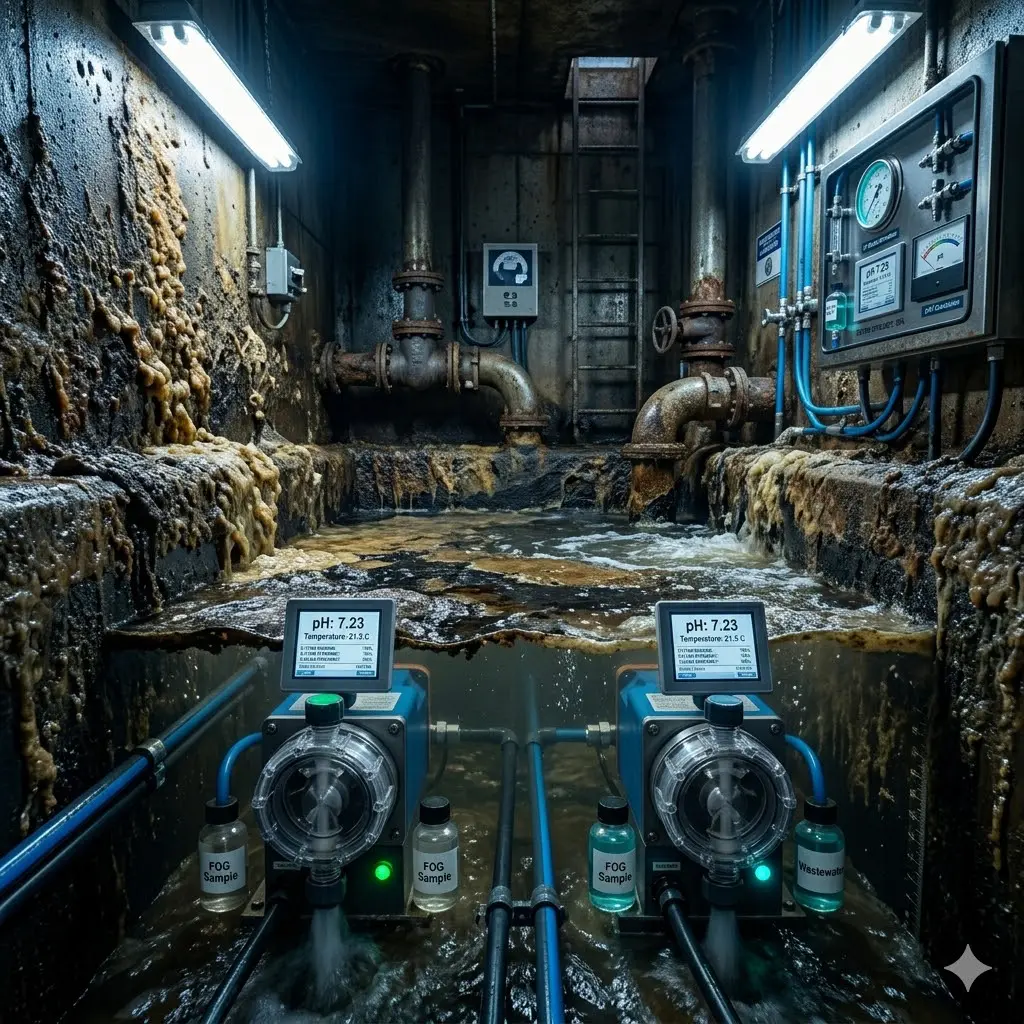
FOG control in wastewater treatment is the systematic management of fats, oils, and grease throughout the collection, conveyance, and treatment system to prevent blockages, protect biological processes, and maintain discharge compliance. FOG — primarily from food processing, commercial kitchens, industrial manufacturing, and rendering operations — enters the wastewater stream as a liquid, cools and solidifies in pipes and pump stations, and accumulates as a floating layer in treatment units that disrupts aeration, inhibits microbial activity, and increases sludge volume. Effective FOG control addresses the problem at multiple points: source control and pretreatment, collection system chemistry, biological augmentation, and pH optimization to improve FOG solubility before it reaches the treatment plant.
We design FOG control programs around your system's specific sources, your collection infrastructure, and your treatment process — not a single product added at one point and hoped for the best. The right chemistry at the right application point, monitored continuously. FOG stays in solution. Biology performs. Pump stations stay clean. Discharge compliance holds.
Share of municipal wastewater system blockages attributed to fats, oils, and grease accumulation per EPA data
Improvement in FOG solubility achievable with optimized pH through pHREADY chemistry at the collection system application point
ChemREADY addresses FOG at every stage — collection, conveyance, biological treatment, and final discharge
Most FOG problems are not a collection system problem or a treatment plant problem — they are a chemistry program problem. The right treatment at the right point eliminates the buildup before it becomes a maintenance event.

Send us a sample — we'll run the analysis and translate it into plain-language recommendations for your treatment program.
FOG solidifies because of low pH and temperature drop in collection system pipes. ChemREADY's pHREADY adds non-carbonate alkalinity at the collection system entry point, raising pH to increase FOG solubility by up to 10x and keeping grease in suspension rather than depositing on pipe walls, pump impellers, and force main surfaces. Applied through a single feed unit, pHREADY works continuously from source through conveyance — so FOG arrives at the treatment plant in a manageable form instead of as accumulated deposits.
Read More →When FOG reaches the biological treatment stage, the right microbial population determines whether it gets broken down or builds up as a floating blanket that disrupts aeration and kills nitrification performance. ChemREADY's BioREADY introduces a targeted consortium of FOG-degrading bacteria that work alongside indigenous populations to accelerate grease breakdown, reduce sludge volume, eliminate FOG blankets in digesters and lagoons, and restore biological treatment performance without process disruption.
Read More →Pump stations are where FOG accumulation becomes an operations emergency. Grease coating impellers, coating wet well walls, and accumulating in force mains creates maintenance cycles that are reactive, expensive, and avoidable. ChemREADY deploys targeted chemistry programs — pHREADY for solubility, SulfAWAY for concurrent hydrogen sulfide control, and BioREADY for biological degradation — at pump station application points to keep wet wells clean and pump runtime costs down.
Read More →The right FOG control program starts with knowing where FOG is entering your system, at what concentration, and what your treatment process can handle. ChemREADY's free water analysis evaluates your influent FOG loading, collection system chemistry, biological treatment capacity, and discharge permit requirements — then designs a program with specific chemistry, application points, dosing rates, and monitoring checkpoints mapped to your actual system. Not a product recommendation. A program.
Read More →Every FOG problem has a source — and treating only one point in the system moves the problem downstream instead of solving it. Our program identifies where FOG is entering, where it is accumulating, and what chemistry at what point eliminates it before it becomes a compliance or maintenance event.
Before any program recommendation, ChemREADY establishes where FOG is coming from and at what loading rate. Source assessment covers influent FOG concentration (mg/L), contributing industries and discharge points, grease interceptor performance upstream, collection system inspection data, and biological treatment FOG loading history — mapped against your system to identify the highest-impact application points.
FOG deposits at its fastest in collection system pipes and force mains where pH is lowest and temperature drops cause grease to solidify. ChemREADY applies pHREADY at strategic collection system entry points to raise pH, increase FOG solubility by up to 10x, and keep grease in suspension through conveyance. A single feed unit installation provides continuous coverage without requiring per-pump-station chemical management.
ChemREADY's BioREADY bioaugmentation program introduces a specialized consortium of FOG-degrading microorganisms — aerobic and facultative bacteria with strong lipase enzyme activity — that break down triglycerides and fatty acids in aeration basins, digesters, and lagoons. Dosing is calibrated to your influent FOG loading and system hydraulic retention time, with adjustment based on effluent quality and sludge volume data at every service cycle.
Pump stations are the most visible point of FOG accumulation and the first place maintenance costs spike when a FOG program fails. ChemREADY deploys an integrated pump station chemistry program — pHREADY for grease solubility, SulfAWAY for hydrogen sulfide suppression, and BioREADY for biological degradation of accumulated organics — applied through automated dosing systems with remote monitoring to maintain continuous coverage.
Source control is the most cost-effective FOG management strategy. ChemREADY supports industrial and commercial facilities in establishing effective grease interceptor programs — sizing guidance, cleaning frequency recommendations, BioREADY augmentation for interceptor performance, and pretreatment compliance documentation to support municipal permit requirements.
FOG blankets in aeration basins block oxygen transfer, inhibit aerobic microbial activity, and contribute to excess sludge generation and Nocardia foam formation. ChemREADY's BioREADY program restores biological treatment performance by degrading accumulated FOG in the mixed liquor, reestablishing oxygen transfer efficiency, and stabilizing the microbial community — measurable through MLSS, SVI, and effluent BOD tracking at every service cycle.
ChemREADY installs automated chemical feed systems at collection system application points and pump stations, with remote monitoring that tracks dosing rates, system chemistry, and FOG indicator parameters continuously. Alerts notify ChemREADY field staff and your operations team when FOG loading spikes or chemistry drifts outside the program design window — so response happens before accumulation does.
Every ChemREADY service visit produces a written report covering FOG loading data, chemistry dosing records, biological performance indicators, pump station condition, and any program adjustments. This documentation supports pretreatment compliance reporting, municipal FOG ordinance requirements, and internal maintenance program records — giving your team a defensible paper trail for any inspection.
Send us a sample — we'll run the analysis and translate it into plain-language recommendations for your treatment program.
A FOG problem does not start with a blocked pipe. It starts with grease coating a pump impeller a little more each week, a floating blanket in the aeration basin getting a little thicker each month, and biology getting a little less efficient each quarter — until one day the maintenance call becomes an emergency call, and the emergency call becomes a compliance notice.
ChemREADY’s managed FOG control programs address the accumulation before it reaches any of those thresholds. Source-to-Discharge chemistry coverage, biological augmentation, automated dosing, and documented service reporting keep your system running in the conditions it was designed for — without the reactive maintenance cycle that FOG creates when it goes unmanaged.
The result: cleaner pump stations, healthier biology, lower maintenance costs, and a FOG program you can document for any pretreatment compliance inspection.
Our formulations meet NSF safety standards to protect your people and your equipment.

Backed by decades of industry experience and a proven track record of results.

Serving facilities across the midwest with responsive, local water treatment support.
Book a 30-minute conversation directly. We'll discuss your wastewater treatment situation and whether working together makes sense.
Book a 30-minute call →Take a look at our wastewater treatment services first. See where you stand across discharge compliance, effluent quality, and chemical treatment programs — then decide if a conversation makes sense.
Find out what a buyer would see →Browse everything we do in wastewater treatment — chemicals, equipment, and services — at your own pace, no conversation required.
Explore our wastewater solutions →We work with advisors who encounter infrastructure gaps in industrial wastewater client businesses. If you're looking for a referral partner for pre-sale readiness work, let's talk.
Learn about our partner program →