Reading Time | 10 Minutes
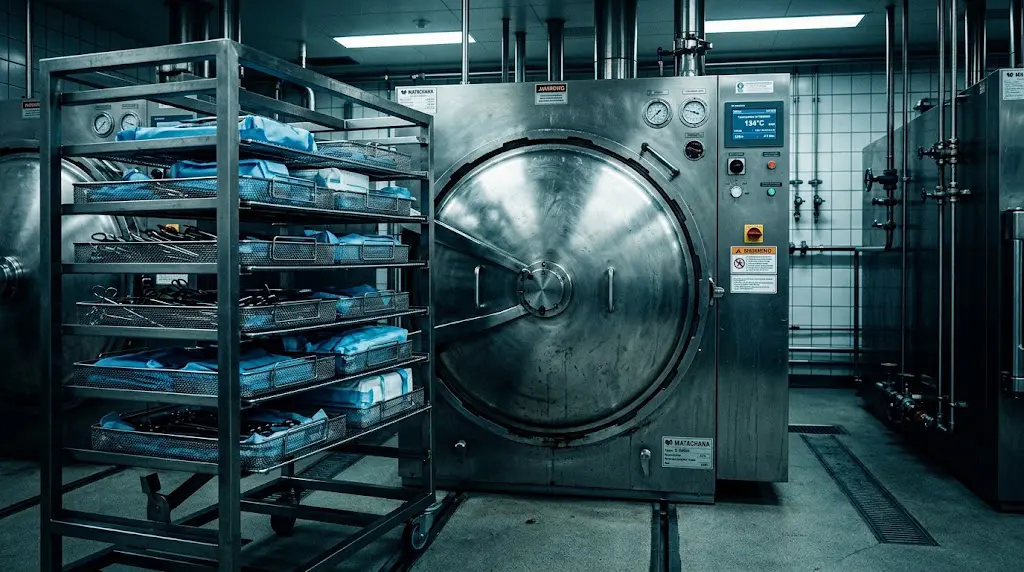
The EHS director at a mid-size regional hospital had done her homework before the Joint Commission survey. The Legionella water management plan was in order. The cooling tower logs were current. The risk assessments were filed.
Then the auditor asked about the sterile processing department’s water program.
She didn’t have an answer. Nobody did.
The citation that followed wasn’t about Legionella or cooling towers. It traced back to a standard called ANSI/AAMI ST108 — the water quality standard for sterile processing departments — that her facility had never formally addressed. This story plays out more often than most healthcare EHS directors realize.
ANSI/AAMI ST108 is the national standard specifying water quality requirements for water used in healthcare sterile processing departments — including water for washer-disinfectors, steam sterilizers, ultrasonic cleaners, and final rinse steps. Any healthcare facility that reprocesses reusable surgical instruments is subject to ST108, regardless of size or accreditation body.
The standard distinguishes between different grades of water used at different processing stages: utility water for initial cleaning, critical water for final rinse and rinsing after decontamination, and pure steam for autoclaving. The requirements for each grade differ, and a compliant program addresses all three.
Most hospitals, ambulatory surgery centers, and outpatient procedure facilities fall under ST108’s scope. If instruments are sterilized and returned to use at your facility, the water used throughout that process is expected to meet specific, testable quality limits.
Most healthcare facilities don't have a documented, tested program. A free ChemREADY water analysis tells you exactly where you stand.
Schedule your free water analysis →ST108 sets measurable limits across multiple parameters. The following are core monitoring requirements for critical water — the grade used in final rinse and sterilization stages:
| Parameter | ST108 Critical Water Limit | Why It Matters |
|---|---|---|
| Total Hardness | < 1 gpg (17 mg/L) | Scale deposits on instruments and equipment; reduces sterilizer efficiency over time. |
| Conductivity | < 15 µS/cm | Indicates dissolved ionic content; elevated conductivity signals contamination or treatment failure. |
| pH | 5.0 – 7.0 | Out-of-range pH accelerates corrosion on stainless steel instruments and chamber surfaces. |
| Silica (SiO₂) | < 1 mg/L | Deposits pit and cloud instrument surfaces and optics. |
| Chloride | < 2 mg/L | Causes pitting corrosion in stainless steel instruments and sterilizer chambers. |
| Bacteria | < 10 CFU/100 mL | Microbial contamination at final rinse directly compromises sterility assurance. |
| Endotoxins | < 0.25 EU/mL | Endotoxins survive sterilization; must be controlled at the water source. |
| Total Organic Carbon | < 0.5 mg/L | Organic matter interferes with sterilant chemistry and rinse validation. |
These are not aspirational targets. They are specific, testable limits that a compliant water program verifies on a documented schedule. A facility that cannot produce testing logs for these parameters during a JCAHO or DNV survey is not in a defensible position.
The short answer: it doesn’t belong to anyone clearly, so it often belongs to no one.
Facilities engineering controls the water supply — the softeners, the RO units, the feed lines. The sterile processing department (SPD) operates the equipment — the washers, the sterilizers, the ultrasonic cleaners. Infection control monitors downstream outcomes. And EHS is expected to connect all of it in a survey.
In most facilities, what actually exists is a patchwork: a water softener serviced annually, an RO membrane changed on a rough schedule, and a sterilizer log maintained by the SPD. But there is no documented water quality program — no regular testing against ST108 limits, no quality targets on paper, and no corrective action protocol when a parameter drifts out of range.
This isn’t a failure of intent. It’s a failure of structure. ST108 compliance requires cross-departmental ownership and a testing cadence that spans facilities engineering and the SPD simultaneously. That doesn’t happen without a formal program driving it.
Most facilities also assume that the presence of a water treatment system — a softener, an RO unit — means water quality is being managed. An RO unit producing water is not the same as an RO unit consistently producing water that meets ST108 limits. The difference only becomes apparent when you test against the standard on a documented schedule.
The Joint Commission doesn’t publish a specific ST108 checklist, but surveyors evaluating SPDs consistently review the following areas. Any of these may be requested on-site, in any order:
A compliant program has three components that work together: defined quality targets, a testing and monitoring cadence, and a documented corrective action process.
Defined quality targets means your facility has documented which ST108 water grade is required at each point in the instrument reprocessing cycle, with the specific parameter limits for each grade written down and assigned to a responsible department.
A testing cadence means water is tested proactively, on a defined schedule — not when something seems wrong. For critical water, a baseline program includes monthly testing for chemical parameters and weekly monitoring for microbial indicators, with more frequent testing after system changes or maintenance events.
A documented corrective action process means that when a parameter drifts, there is a defined response: who is notified, what investigation is triggered, what remediation steps are taken, and how the correction is verified and recorded. That record is what turns a compliance gap into a closed finding.
Most facilities that manage water quality in sterile processing do so reactively — they address failures after they occur rather than maintaining a program that prevents them. A managed water program built around ChemREADY’s AAMI ST108 services is the difference between reactive repair and documented, continuous compliance.
Beyond the audit risk, out-of-spec water in sterile processing creates two downstream cost problems that rarely get connected to water quality in budget conversations.
On the equipment side: sterilizers, washers, and ultrasonic cleaners running on hard, high-chloride, or high-TDS water experience accelerated scaling, chamber corrosion, and surface pitting. A large autoclave represents a $100,000–$200,000 capital asset. Water-related degradation shortens useful life measurably and increases service frequency in ways that appear in the maintenance budget long before anyone connects them to water quality.
On the patient safety side: water that fails ST108 parameters at the final rinse stage can leave microbial or endotoxin contamination on instrument surfaces that survives the sterilization cycle. This is a low-probability but high-consequence failure mode — the kind that generates regulatory scrutiny, adverse event investigations, and liability exposure.
A managed water program is the only way to know — continuously, not after the fact — that the water feeding your sterile processing operations is within the range required to support sterility assurance.
Our free water analysis covers the full critical water set — hardness, conductivity, pH, chloride, endotoxins, and more. You'll know exactly where your facility stands.
Schedule your free water analysis →A free water analysis tells you where your testing, water quality, and documentation actually stand — before a JCAHO or DNV survey does.
Schedule your free water analysis →Or call us directly: 800-229-6801
A managed program with defined quality targets, a testing and monitoring cadence, and a documented corrective-action trail.
Explore the ST108 program →ASHRAE 188-aligned plans that stay living documents — sampling schedule, action levels, and a corrective-action trail.
Explore water management plans →Explore our healthcare water safety services — testing, program development, and consulting for facilities under regulatory scrutiny.
See water safety services →