ChemREADY

Reading Time | 5 Minutes
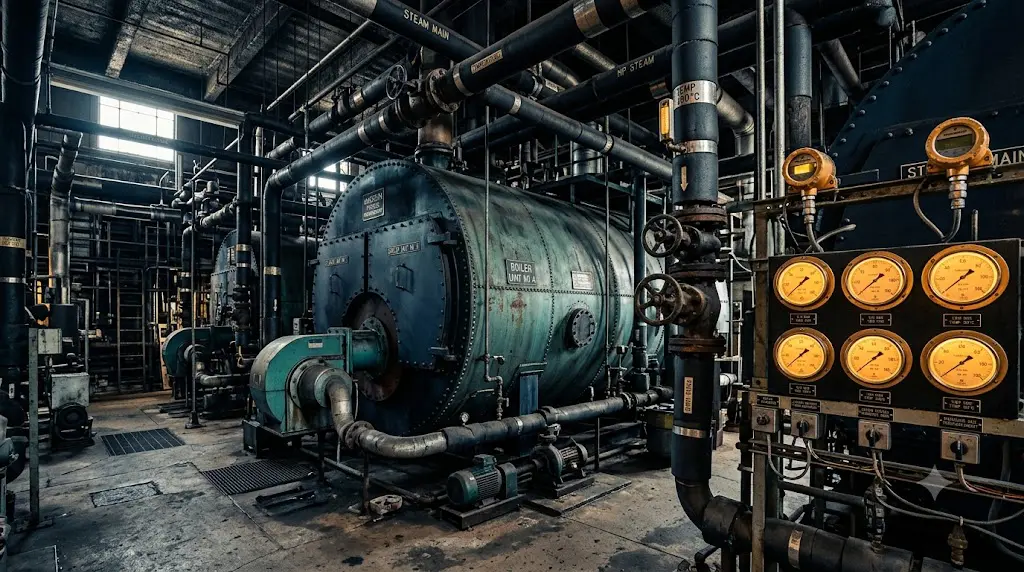
A 1/16-inch scale deposit on a boiler heat transfer surface increases fuel consumption by up to 12%. That’s not a failure scenario — that’s what accumulates when a boiler blowdown program stops matching actual system conditions.
Most blowdown schedules were set once, at commissioning, and never revisited. Meanwhile makeup water quality, load, and operating pressure all moved. This is about closing the gap between the system you started with and the one you’re running now — before it shows up on your fuel bill through avoidable scale and corrosion.
Boiler blowdown is the controlled discharge of concentrated boiler water to remove accumulated total dissolved solids (TDS) that the steam production process can’t remove on its own. A boiler blowdown program is the combination of surface and bottom blowdown intervals, conductivity setpoints, and monitoring frequency that keeps TDS within design limits.
When TDS climbs past those limits, scale forms — and scale is expensive. That’s where a managed boiler water treatment program earns its keep: it keeps the setpoints honest against conditions that don’t hold still.
The startup engineer calibrated intervals and conductivity setpoints based on makeup water quality, load, and operating pressure at that moment. Then the program ran unchanged while everything else shifted.
Makeup water quality changes with the seasons, with municipal treatment adjustments, or when a facility switches sources. Steam demand fluctuates as operations evolve. Predictable load cycles become irregular. The blowdown schedule keeps running on its original assumptions — and the gap between those assumptions and current conditions grows.
Scale accumulates with no alarm and no error code — just a slowly rising fuel bill. ChemREADY boiler services build blowdown decisions around live conductivity data instead of a schedule from three years ago.
See What's Included in Boiler Services →| Condition | What’s Happening | Consequence |
|---|---|---|
| Over-blowdown setpoint too conservative; conditions improved | Treated boiler water sent to drain — wasting chemicals, heat, and water | Thousands of dollars annually in avoidable loss |
| Under-blowdown setpoint too high; makeup degraded or load up | TDS builds past design limits; scale forms on heat transfer surfaces | 12% fuel increase per 1/16″ deposit; carryover risk; equipment damage |
Carryover deserves specific attention because it’s frequently misdiagnosed. When boiler water solids get carried into the steam, an engineer sees erratic steam trap behavior, unexplained heat-exchanger deposits, or degraded process quality — and chases equipment problems. The real issue is a blowdown program that hasn’t been reviewed since the startup documentation was written.
Measure conductivity in the boiler water on a consistent schedule. Compare it against current design parameters for your makeup water quality and load. Adjust blowdown frequency to match — not the schedule from three years ago.
Digital remote monitoring adds continuous conductivity tracking and out-of-setpoint alerts across multiple boilers or sites — so you find out conditions have drifted without waiting for the next scheduled visit. What we typically find when we walk a boiler that hasn’t had professional attention in a while is a startup document nobody has revisited, and a boiler operating outside the conditions it was designed for.
Your commissioning engineer set the right parameters for the system as it was. The question is whether those parameters still match the system as it is.
A water analysis tells you where your TDS, conductivity, and makeup quality actually sit today — and whether your blowdown program is over-blowing, under-blowing, or dialed in. ChemREADY benchmarks it against your design targets and shows you what to adjust.
Request Your Free Water Analysis →Running boilers across multiple sites? See how digital remote monitoring keeps every setpoint honest →
Book a 30-minute conversation. We'll walk through your conductivity setpoints, makeup water quality, and current blowdown schedule — and tell you straight whether it still matches your system.
Book a 30-minute call →Start with data instead of a conversation. A water analysis tells you what your blowdown schedule can't — where your TDS, conductivity, and makeup water quality actually sit today, and whether you're over-blowing or under-blowing.
Request a water analysis of your boiler →See what goes into an active boiler water treatment program — conductivity monitoring, blowdown calibration, scale and corrosion control, and carryover prevention — before you talk to anyone.
Explore our boiler services →We work with plant and facilities teams managing boiler fleets across locations. Digital remote monitoring gives you continuous conductivity tracking and out-of-setpoint alerts on every boiler — without waiting for the next scheduled visit to find out conditions drifted.
See how digital remote monitoring works →