Reading Time | 7 Minutes
Walk into most facilities with a filter press and ask how the chemical program works. You’ll hear about polymer — the dose, the type, maybe a recent adjustment when cycle times got long. What you usually won’t hear about is coagulation.
That gap is where a significant share of filter press performance problems start — and where most of them stay unresolved. Wet cake, extended cycle times, and turbid filtrate are the symptoms. An incomplete chemical program is usually the cause.
This post explains what coagulation is, how it works with your polymer program, and what facilities that have skipped the coagulation step are leaving on the table in cake quality, cycle time, and disposal costs.
Coagulation in wastewater treatment is the process of adding a chemical coagulant to neutralize the electrical charge on suspended particles, allowing them to come together and be captured by a downstream flocculant and filter media. Without coagulation, fine particles in industrial wastewater remain electrostatically dispersed and resist aggregation regardless of how much polymer is added.
The chemistry works in two stages that must happen in sequence:
Stage 1 — Coagulation: A coagulant is added to the raw wastewater. The coagulant carries a charge opposite to the negative surface charge on suspended particles. When the charges neutralize, the particles lose their repulsion and become receptive to bonding. This is rapid-mix chemistry — it happens in seconds.
Stage 2 — Flocculation: A polymer flocculant is added to bridge and aggregate the now-destabilized particles into larger floc structures that can be captured by the filter cloth and form a coherent cake. Flocculants work by molecular bridging — they’re long-chain polymers that connect multiple particles into a filterable mass.
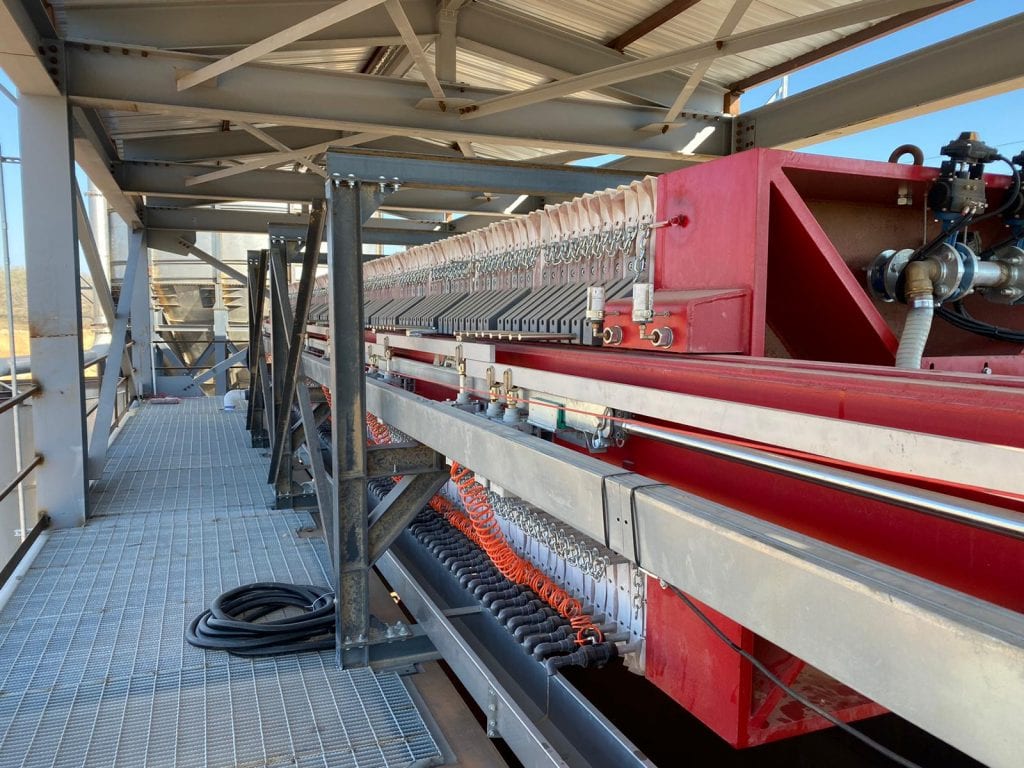
Skip or under-dose Stage 1, and Stage 2 cannot fully compensate. Polymer bridging requires destabilized particles to work with. If the particles still carry their original charge, the floc that forms is weaker, breaks apart under press pressure, and produces wet cake with every cycle. If you want the mechanics of the equipment side, our overview of how a filter press works covers how that cake forms and releases.

Many facilities are running polymer-only programs without realizing it. A free water analysis includes a review of your current dewatering chemistry.
Talk to a Water Treatment Specialist →
Coagulants and flocculants do fundamentally different jobs in a filter press program. The confusion between them — or the assumption that one covers both functions — is the most common source of incomplete programs.
| Coagulant | Flocculant (Polymer) | |
|---|---|---|
| Primary function | Destabilizes particle charge | Bridges particles into filterable floc |
| Chemistry type | Inorganic salt or organic cationic polymer | Long-chain synthetic polymer (anionic, cationic, or non-ionic) |
| Mixing requirement | Rapid mix (seconds) | Slow mix / gentle agitation |
| Effect without the other | Particles destabilized but not aggregated — won’t filter | Polymer works against charged particles — weak floc, poor cake |
| Common products | Ferric chloride, alum, organic coagulants | Anionic, cationic, or non-ionic polyacrylamide |
The practical implication: if your program consists only of polymer addition — which is common in facilities where the filter press program was set up at installation and hasn’t been revisited — you’re running Stage 2 without Stage 1. The press is working. The chemical program isn’t complete.
The choice between organic and inorganic coagulants depends on your feed chemistry, pH range, and operational priorities.
| Factor | Inorganic (Ferric Chloride / Alum) | Organic (Cationic Polymer) |
|---|---|---|
| Best for | High-turbidity, variable-chemistry streams; wide pH range | Negatively charged organics; lower-TSS, more pH-sensitive applications |
| Sludge volume | Higher — metal salt precipitates add to cake volume | Lower — no metallic precipitates |
| Cost | Lower product cost, higher disposal cost (more cake) | Higher product cost, lower disposal cost (less sludge) |
| pH sensitivity | Works across wider pH range (5–9) | More sensitive — requires tighter pH control |
Most facilities running inorganic coagulants chose them because they were specified during equipment installation. Whether that choice is still optimal for today’s feed — which may be different from the feed at commissioning — is a question most programs never revisit. Coagulants should be selected based on current feed chemistry analysis, not on what was in the original spec. The upstream pH and alkalinity control on your stream directly affects which coagulant will perform.
Particle type, pH, TSS concentration, and temperature all affect which product works. Our dewatering optimization program assesses your two-stage chemistry against your actual feed.
Explore Dewatering Optimization →Wet cake is the most common complaint in facilities with incomplete coagulation programs — and the most commonly misdiagnosed. The standard response is to increase polymer dose. When inadequate coagulation is the root cause, more polymer doesn’t fix it.
Diagnosing the actual cause requires systematically checking the right variables. Here’s the diagnostic sequence:
What we find in most facilities we start working with is that the polymer program has been recently adjusted — because something was visibly off — but the coagulation program, if one exists, hasn’t been touched since installation. The adjustment didn’t solve the problem because it was targeting the wrong stage. (If filtrate turbidity points you toward the cloth, the cake’s waste classification can shift as performance drifts — a separate compliance risk worth understanding.)
A complete dewatering program reviews both chemical stages together and connects program performance to operational outcomes: cake moisture, cycle time, disposal weight, and filtrate quality. Without that connection, the press runs, the problems persist, and the cause stays unidentified.
Dewatering optimization starts with understanding what’s in the feed and what the two-stage chemistry is actually doing to it. That’s not something a chemical delivery schedule does — it’s what a managed dewatering program does.
ChemREADY offers a free on-site water analysis — we'll assess your dewatering chemistry, test your feed and filtrate, and give you a plain-English report on what we find. No obligation.
Talk to a Water Treatment Specialist →800-229-6801
Book a 30-minute conversation directly. We'll discuss your dewatering and solids management situation and whether working together makes sense.
Book a 30-minute call →Take a look at our dewatering services first. See where you stand across polymer programs, filter press performance, and solids handling infrastructure — then decide if a conversation makes sense.
Find out what a buyer would see →Browse everything we do in dewatering — chemicals, equipment, and services — at your own pace, no conversation required.
Explore our dewatering solutions →We work with advisors who encounter infrastructure gaps in solids management and dewatering client businesses. If you're looking for a referral partner for pre-sale readiness work, let's talk.
Learn about our partner program →