ChemREADY

Reading Time | 5 Minutes
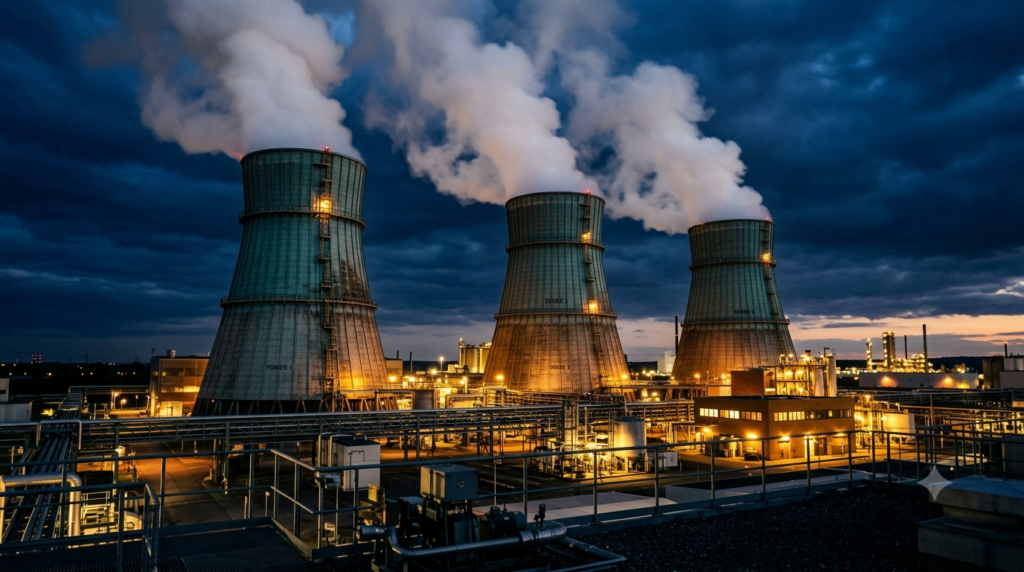
Fifty-four confirmed cases. Eighteen people hospitalized. More than thirty buildings on Manhattan’s Upper East Side flagged for Legionella in their cooling towers — and the outbreak is still active as of this writing.
If you operate a cooling tower, this is not background noise. It is a direct read on what happens when a cooling tower Legionella program drifts out of active management — when biocide dosing becomes a delivery schedule instead of a verified control loop.
Legionella pneumophila proliferates in cooling towers because recirculating water between 77°F and 113°F, combined with continuous aerosolization, creates ideal growth conditions. A cooling tower Legionella program is the combination of verified biocide treatment, environmental testing, and documented inspection that keeps bacterial concentrations below actionable thresholds. Without it, a tower can become a Legionella source within weeks.
Scale, biofilm, and suspended solids all accelerate that curve — which is why cooling tower water treatment and side stream filtration are not separate from Legionella control. They are Legionella control.
More than half of the cooling towers in the investigated area had outstanding violations in the months before cases were reported. Not abandoned buildings — operating facilities that drifted out of compliance while nobody was tracking it.
Legionella accumulates in systems where residuals aren’t verified at the tower, drift eliminators aren’t maintained, and treatment amounts to a delivery schedule. Digital remote monitoring and controllers and automation exist precisely because “someone will check it next visit” is not a control strategy in July.
If any row lands in the right-hand column, that's the gap an inspector — or an outbreak investigation — finds first. ChemREADY field techs verify residuals at the tower, run the testing schedule, and keep the records audit-ready.
See What's Included in Cooling Tower Services →| Component | Compliant Program | Non-Compliant Program |
|---|---|---|
| Biocide verification | Field-verified residuals at the tower, on schedule | Delivery logged; no field verification |
| Environmental testing | Monthly HPC; quarterly Legionella-specific minimum | Sporadic or post-incident testing only |
| Documented inspections | Drift eliminator, basin, fill media records per WMP — retrievable in 15 minutes | Verbal or no inspection records |
| Corrective action protocol | Written triggers with documented closure | “We’ll call someone” — no defined triggers |
Every one of those rows lives inside a Legionella water management plan built to ASHRAE 188. A chemical drop-off is a supply arrangement. A Legionella treatment program is what happens between deliveries.
ASHRAE 188 requires the schedule to be defined in your Water Management Plan. In practice: heterotrophic plate counts monthly during the operating season, and Legionella-specific testing quarterly at minimum — plus after any shutdown, corrective maintenance, or process change.
New York is now requiring immediate cleaning and disinfection of every tower with a positive result — and publishing building addresses. Facilities that can produce documented test logs are in a fundamentally different position than facilities that can’t.
It is mid-July. Your tower is at peak load, evaporation is at its annual high, and Legionella risk tracks heat. You either find out you had a problem, or you find out you didn’t. The difference is whether someone was actively looking.
A water analysis tells you what your delivery logs can't. ChemREADY tests your tower water, benchmarks it against your control targets, and shows you exactly which gaps to close before peak season does it for you.
Request Your Free Water Analysis →Already know you need a plan? Build or audit your Legionella Water Management Plan →
Book a 30-minute conversation. We'll walk through your current biocide program, testing schedule, and documentation — and tell you straight where the gaps are.
Book a 30-minute call →Start with data instead of a conversation. A water analysis of your tower tells you what your delivery logs can't — where your residuals, microbiological counts, and control targets actually sit right now.
Request a water analysis of your tower →See what goes into a Legionella Water Management Plan built to ASHRAE 188 — control points, testing schedules, corrective action triggers, and documentation — before you talk to anyone.
Explore Legionella Water Management Plans →We work with property groups, healthcare systems, and consulting engineers who need one consistent Legionella program across a portfolio — same protocol, same documentation, same audit readiness at every site.
See our cooling tower services →