ChemREADY

Reading Time | 5 Minutes
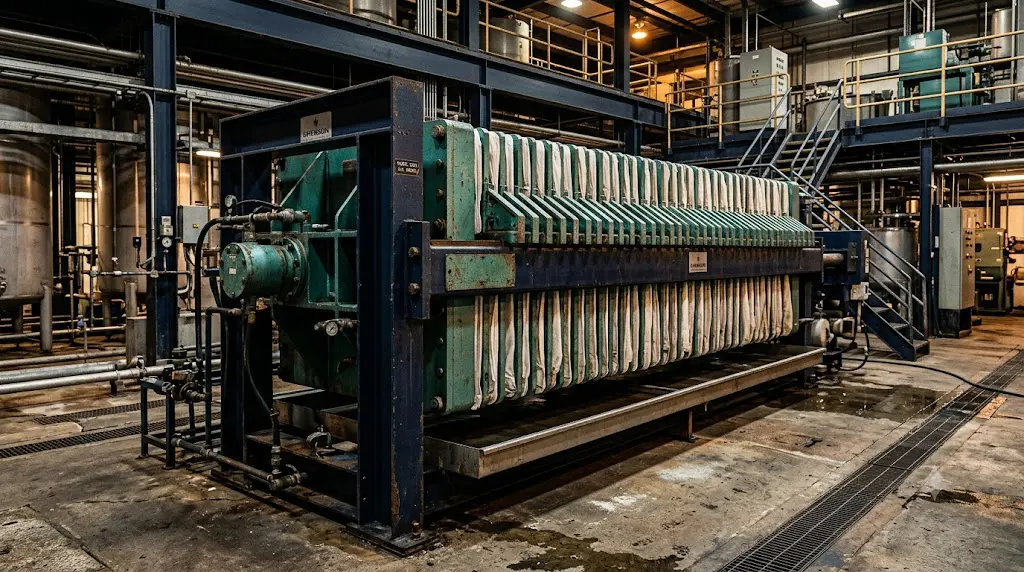
Ask an EHS director about their filter press and the conversation almost always starts with cake — what’s in it, how it’s classified, where it’s going, what the RCRA implications are. The solid side gets the scrutiny.
What often doesn’t is the filtrate returning to drain every time the press cycles. And filter press filtrate compliance carries exposure most facilities never account for — because the liquid leaving your press is subject to the same permit limits as everything else that goes down the drain.
Filter press filtrate is the liquid that passes through the filter cloth during the press cycle and returns to the facility drain system. It’s the liquid fraction separated from the solid cake — and filter press filtrate compliance requires that this discharge meets the same pretreatment permit limits as all other regulated wastewater from the facility.
Filtrate quality is determined by feed stream chemistry, operating pH, flocculant program effectiveness, and filter cloth condition — and it changes when any of those variables change. Equipment matters here too: a properly matched filter press and correctly specified cloth are the difference between filtrate that meets limits and filtrate that doesn’t.
The compliance risk is the lag time. Most industrial discharge permits set monthly or quarterly sampling requirements. A process change that degrades filtrate quality can run four to six weeks before a scheduled monitoring event catches it.
Suspended solids that were capturing cleanly in the cake start carrying through. Metals that precipitated at one operating pH don’t precipitate as efficiently when pH shifts. COD loads climb — and the resulting permit violation is documented as a compliance event with no record of what triggered it. A properly dosed flocculant and coagulant program is what keeps that capture consistent as the feed stream moves.
If a violation lands during a period of process change, regulators ask what changed and what caught it. ChemREADY builds filtrate monitoring tied to your process-change cycle — not just your permit schedule — so you have a defensible answer.
See Our Wastewater Treatment Services →There’s also a cloth factor that rarely gets factored into compliance planning. Blinded or worn filter cloth forces liquid through pathways that aren’t primary filtration surfaces — the result is elevated suspended solids in the discharge, even when the press is otherwise running normally.
This is something our technicians catch regularly during routine service visits: cloth that looks intact from the outside but is passing solids it shouldn’t. Side-stream and polishing filtration can add a defensive layer, but nothing replaces knowing your cloth condition and testing against it.
| Trigger | What Changes | Monitoring Action |
|---|---|---|
| Upstream chemistry change | New chemicals, throughput increase, formulation change | Filtrate characterization test before restart |
| Operating pH shift | pH setpoint adjusted; feed acidity/alkalinity changed | Filtrate metals + TSS test within 48 hrs |
| Seasonal raw material variation | Feedstock changes affecting feed stream composition | Filtrate review at start of each seasonal cycle |
| Cloth wear or blinding | Longer cycle times, reduced cake dryness, elevated TSS | Effluent assessment alongside cloth inspection |
| Post-downtime restart | System idle 30+ days, maintenance performed | Full characterization before resuming discharge |
If your pretreatment records show consistent compliance and then a violation occurs during a period of process change, regulators will ask two questions: what changed, and what monitoring was in place to detect it? A filtrate sampling program tied to your process-change review cycle — not just your permit schedule — is the documentation that answers those questions defensibly.
Digital remote monitoring of filtrate conductivity and pH adds a continuous early-warning layer between sampling events, so quality drift surfaces before the next compliance test does.
The cake is important. So is what goes down the drain.
A water analysis characterizes your filtrate against your permit limits — TSS, metals, COD, pH — and shows you where you stand before your next sampling event does. ChemREADY benchmarks the results and flags what to correct.
Request Your Free Water Analysis →Want continuous coverage between samples? See how digital remote monitoring closes the 4–6 week gap →
Book a 30-minute conversation. We'll walk through your filtrate handling, permit limits, and monitoring cadence — and tell you straight where your exposure is before an audit finds it.
Book a 30-minute call →Start with data instead of a conversation. A water analysis characterizes your filtrate against your permit limits — TSS, metals, COD, pH — and shows you where you stand right now, before your next scheduled sampling event does.
Request a water analysis of your filtrate →See what goes into a managed discharge compliance program — filtrate characterization, trigger-based monitoring, flocculant program management, and audit-ready documentation — before you talk to anyone.
Explore our wastewater treatment services →We work with EHS and environmental teams responsible for pretreatment compliance across several sites. Digital remote monitoring adds continuous filtrate conductivity and pH tracking with out-of-range alerts at every location — so drift surfaces before the next sampling event, not after.
See how digital remote monitoring works →