Heavy Metals Removal in Industrial Wastewater: What Your Permit Actually Requires

Reading Time | 5 Minutes

Heavy metals permit limits have no tolerance band. Lead at 0.2 mg/L means 0.2 mg/L — not 0.21 on a bad production day, not 0.25 during a rinse cycle changeover. Industrial facilities generating wastewater with lead, chromium, copper, zinc, cadmium, or nickel operate under some of the strictest numeric limits in pretreatment permitting, and a single exceedance in a self-monitoring sample can trigger a compliance sequence that takes months to resolve.

Most affected facilities are sampling on schedule. Fewer have a current, verified understanding of how their metals removal chemistry is performing against their permit limits under actual operating conditions.

What Is Hydroxide Precipitation in Wastewater Treatment?

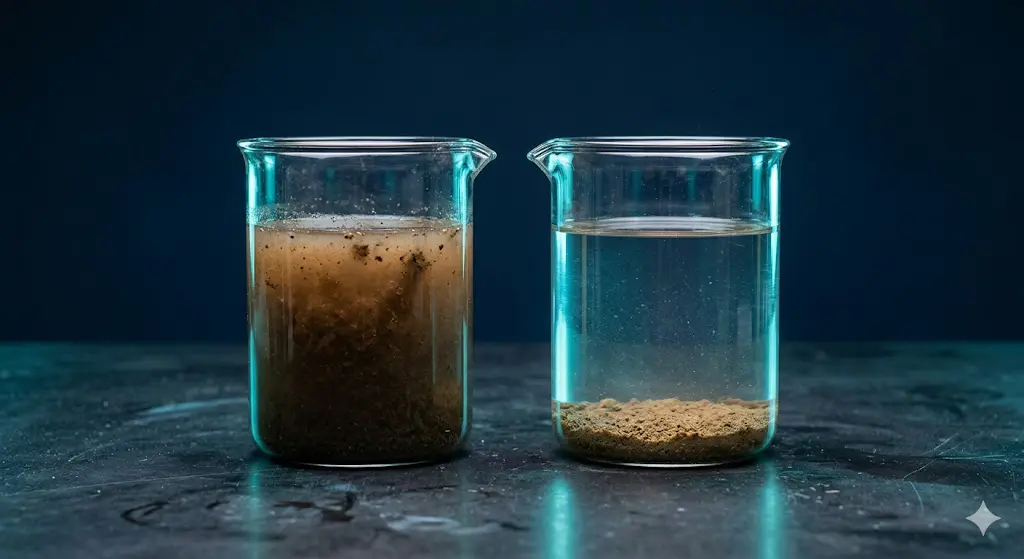
Hydroxide precipitation is the process of adding an alkali — typically sodium hydroxide, lime, or caustic soda — to industrial wastewater to raise pH to a range where dissolved heavy metal ions react with hydroxide ions to form insoluble metal hydroxide precipitates that can be removed by sedimentation or filtration. It is the primary treatment mechanism for removing lead, chromium, copper, zinc, cadmium, and nickel from industrial discharge streams, and it is pH-dependent: each metal has a specific pH window at which it achieves its lowest solubility.

Don't Know What Metals Your Discharge Actually Contains?

You can't manage a metals removal program around data you don't have. ChemREADY's free wastewater sample test establishes your baseline.

Request Your Free Wastewater Sample Test →

What pH Removes Heavy Metals from Wastewater?

The pH required for effective metals removal varies by metal species. This is the most operationally important table in metals pretreatment management:

Metal Optimal Removal pH Min. Solubility Notes
Chromium (III)7.5 – 9.0~8.0Must reduce Cr(VI) to Cr(III) first if hexavalent chromium is present
Copper8.0 – 9.5~9.0Re-dissolves above pH 10.5 (amphoteric); don’t over-shoot
Lead8.0 – 9.5~9.0Relatively easy to precipitate; most permits set very low limits (<0.2 mg/L)
Zinc9.0 – 10.5~10.0Amphoteric — re-dissolves above pH 11; tight operating window
Nickel9.5 – 10.5~10.5Higher pH requirement than most other metals; needs careful control
Cadmium9.0 – 10.0~9.5Very strict permit limits (<0.07 mg/L common); low margin for error
Silver8.5 – 9.5~9.0Present primarily in photo processing and electroplating discharge
Arsenic7.5 – 9.0 (Fe co-precip.)pH-dependentOften requires iron co-precipitation for adequate removal

For mixed-metals streams — which describe most industrial facilities — the operating pH window must achieve adequate removal across all regulated species simultaneously. When Zn and Ni both need pH 9.5–10.5 but Cu re-dissolves above 10.5, the effective window can be as narrow as 0.5 pH units. Maintaining consistent pH in that band under variable production load is a chemistry and process control challenge, not just a reagent addition problem. The upstream alkalinity and pH control on your stream is what holds that window.

Is Your System Operating in the Right pH Window for Your Metals?

A program calibrated for one metal rarely covers a mixed stream. See how ChemREADY's metals recovery treatment matches chemistry to your actual discharge profile.

Explore Metals Recovery Treatment →

What Are Typical Heavy Metals Limits in Industrial Pretreatment Permits?

Limits vary by POTW and by regulatory category, but most industrial pretreatment programs operate within these general ranges:

MetalTypical Pretreatment Limit RangeRegulatory Context
Lead0.2 – 0.5 mg/LFederal categorical standard for electroplating; local limits often stricter
Chromium (total)1.0 – 3.0 mg/LHex chrome may have separate, stricter limit (0.05–0.1 mg/L)
Copper1.0 – 3.0 mg/LVaries significantly by POTW; tighter in sensitive watersheds
Zinc1.0 – 5.0 mg/LOften driven by downstream biosolids standards
Nickel1.0 – 3.5 mg/LFederal categorical for electroplating; local programs often stricter
Cadmium0.07 – 0.5 mg/LAmong the strictest industrial limits; minimal margin for error

Your actual limits are in your pretreatment permit or categorical standards determination. The ranges above are starting context — not permit substitutes.

How Do I Prevent Metals Pretreatment Violations?

Most metals pretreatment violations trace back to one of a small set of recurring failure modes. Understanding which one applies to your facility determines what the corrective work actually is:

  1. pH instability during production peaks: Batch acid or alkaline discharge from process operations temporarily overwhelms the treatment system’s buffering capacity, driving pH outside the metals removal window. Continuous pH monitoring catches these events in real time rather than after a sampling event.
  2. Program drift after process changes: A new plating bath chemistry, additional production lines, or a change in rinse volumes alters the metals loading and wastewater chemistry. The treatment program calibrated for the previous process no longer performs adequately.
  3. Inadequate coagulation and flocculation downstream of pH adjustment: Metal hydroxide precipitates are fine particles that don’t clarify efficiently without polymer support. An underperforming coagulant or flocculant program allows metal-bearing solids to pass through to the discharge sample.
  4. Operating pH in the wrong range for the permit’s target metals: A program designed around pH 8.5 that permits lead (optimal at 9.0) and nickel (optimal at 10.5) simultaneously is not achieving optimal removal of both. The permit limits require performance the chemistry isn’t designed to deliver.
  5. Documentation gaps: pH records not aligned with sample collection windows, missing corrective action documentation for out-of-range events, or incomplete chain-of-custody records. The chemistry may be performing correctly, but the documentation doesn’t support a compliant record.

Digital remote monitoring addresses failure modes 1 and 5 simultaneously — it generates the continuous pH record that both catches treatment upsets in real time and supports the documentation record. The Source-to-Discharge™ approach addresses failure modes 2 and 4 by connecting metals loading back to its process sources and verifying that the treatment program is matched to the current discharge profile. Failure mode 3 is a chemistry problem — the right coagulant and flocculant program to capture the fine hydroxide precipitate.

Metals are one of several discharge parameters where documentation, not chemistry, is the usual point of failure — the same gap drives FOG pretreatment violations, and it’s the central issue in the coming wave of PFAS permit monitoring.

What we find when we start working with facilities on metals pretreatment is consistent: sampling is active, results are on file, and no one has recently verified that the treatment system’s operating parameters still match the permit’s requirements. The pH log and the compliance data are in separate binders. The removal program was calibrated at startup and hasn’t been reviewed since. That gap is where violations come from.

Not Sure If Your Discharge Is Where It Needs to Be?

ChemREADY offers free wastewater sample testing — send us a sample and we'll tell you exactly what you're working with. No obligation.

Request Your Free Wastewater Sample Test →

800-229-6801

Prefer to schedule a call?

Book a 30-minute conversation directly. We'll discuss your wastewater treatment situation and whether working together makes sense.

Book a 30-minute call →

What to expect from a first conversation

  • We listen first — your situation, your timeline, your goals
  • We're honest about whether we're the right fit
  • If we're not, we'll point you to someone who is
  • No high-pressure close. Ever.
  • 30 minutes. You'll know if it makes sense to continue.

Not ready to talk yet?

Take a look at our wastewater treatment services first. See where you stand across discharge compliance, effluent quality, and chemical treatment programs — then decide if a conversation makes sense.

Find out what a buyer would see →

Want to explore on your own terms?

Browse everything we do in wastewater treatment — chemicals, equipment, and services — at your own pace, no conversation required.

Explore our wastewater solutions →

Are you an M&A advisor or PE firm?

We work with advisors who encounter infrastructure gaps in industrial wastewater client businesses. If you're looking for a referral partner for pre-sale readiness work, let's talk.

Learn about our partner program →